







Downhole wireline & borehole engineering
Select a 1-conductor monoconductor (3.18–8.20 mm OD) for cased-hole perforating, pressure control and low-rate e-line correlation; a 4-conductor star-quad (4.72–7.94 mm OD, such as 4H18 or 4H25) for slim-hole mineral, coal and hydrogeological winches; a 7-conductor heptacable (9.65–13.20 mm OD, such as 7H42, 7J46 or 7H47) for open-hole multi-sensor oilfield and geothermal toolstrings; and a stainless-FIMT electro-optical wireline (6.60–14.30 mm OD, such as 4SSA27 or FIMT-EO46) whenever Distributed Acoustic/Temperature Sensing (DAS/DTS) or multi-megabit downhole imaging exceeds copper bandwidth.
Why downhole wireline cables standardized on 1, 4, 7 and FIMT core geometries
Unlike fixed tray cables, an armoured wireline logging cable must survive simultaneous axial tension up to 50–151 kN, hydrostatic wellbore pressure up to 100–170 MPa, lubricator grease-head sealing, and multi-layer Lebus spooling across 3,000 m to 9,000 m drum lengths. Only radially symmetric core geometries resist core migration (“birdcaging” or conductor corkscrewing) under two contra-helical layers of galvanized or corrosion-resistant alloy steel armour wires.
Side-by-side comparison across the four wireline logging cable families
| Selection parameter | 1C Monoconductor | 4C Quad (4H18 / 4H25) | 7C Heptacable (7H42 / 7J46) | Electro-Optical FIMT |
|---|---|---|---|---|
| Standard OD window | 3.18 mm to 8.20 mm (1/8 to 5/16 in) | 4.72 mm to 7.94 mm (3/16 to 5/16 in) | 8.26 mm to 13.20 mm (5/16 to 17/32 in) | 3.18 mm to 14.30 mm (optical & hybrid) |
| Breaking strength (MBL) | 12 kN to 56 kN | 17.8 kN to 46.7 kN (up to 115 kN on 6SSA5) | 45.4 kN to 151.0 kN (Slammer / HS grades) | 9.8 kN to 94.0 kN |
| Practical telemetry rate | ~20–100 kbps (center-to-armor return) | ~100–350 kbps (two balanced pairs) | ~500–1,000 kbps (orthogonal phantom modes) | > 1–10 Gbps + continuous DAS / DTS |
| Lubricator pressure seal | Easiest (small single-bore flow tubes) | Compact low-drag grease/pack-off head | Standard 7/16 in & 15/32 in oilfield flow tubes | Compact 6.6–11.8 mm grease-head flow tubes |
| Primary field service | Cased-hole perforating, PLT, plug setting, gamma-CCL | Diamond-drill mineral/coal slim holes, hydrogeology, acoustic televiewer | Open-hole resistivity/nuclear/sonic combos, rotary coring, fluid sampling | Real-time VSP seismic, hydraulic fracture DAS, steam/geothermal DTS |
| TEBAOFLEX schedule | Monoconductor logging | 4H18, 4H25 & 6SSA5 page | 7H42, 7J46 & W7 heptacable | 4SSA27 & FIMT-EO page |
1. Monoconductor (1C): cased-hole pressure control and perforating workhorse
A monoconductor wireline logging cable places a single stranded tinned or nickel-coated copper conductor inside concentric copolymer, ETFE or FEP insulation and two contra-helical steel armour layers—using the outer steel armour itself as the electrical return path. Because finished diameter stays between 3.18 mm (1/8 in) and 8.20 mm (5/16 in), surface pressure-control lubricators require far smaller grease-injection clearances and lower counterweight sinker-bar mass when running into live producing wells under wellhead pressure.
Where cased-hole operations encounter hydrogen sulfide (H2S) or CO2 brine, swap standard galvanized carbon steel for alloy armour on our sour-service wireline cable, or add an extruded polymer seal on our greaseless jacketed wireline cable.
2. Four-Conductor Star-Quad & Borehole Multi-Core: slim-hole mineral and geotechnical winches
Mineral exploration diamond drilling (BQ ~60 mm, NQ ~76 mm, HQ ~96 mm hole sizes), coal-bed methane coring and deep groundwater surveys deploy portable truck- or skid-mounted winches that cannot carry 5 tonnes of 11.8 mm oilfield heptacable. Four-conductor star-quad borehole logging cables (`4H18RPP` / `A240185` at 4.72 mm and `4H25` / `A240250` at 6.35 mm) solve that drum-weight bottleneck while still giving instrument designers four independent insulated conductors:
- Dedicated DC power + isolated differential signal pair: Unlike a monoconductor, tool DC supply does not have to share the noisy earth-return path with millivolt spontaneous-potential (SP), induced-polarization (IP) or spinner-flowmeter pulses.
- Specialty 3-conductor & coax-hybrid borehole builds: Dedicated acoustic/optical borehole televiewers and large-shaft mine inspection winches also use heavy 3-conductor (`3Q37RP` 9.58 mm, `3H47` 12.04 mm) or coaxial-plus-control (`6SSA5` 15.85 mm with `3×RG59 + 6×20 AWG`) constructions covered on the same quad and borehole geophysical schedule.
3. Seven-Conductor Heptacable (6+1): open-hole petroleum and geothermal standard
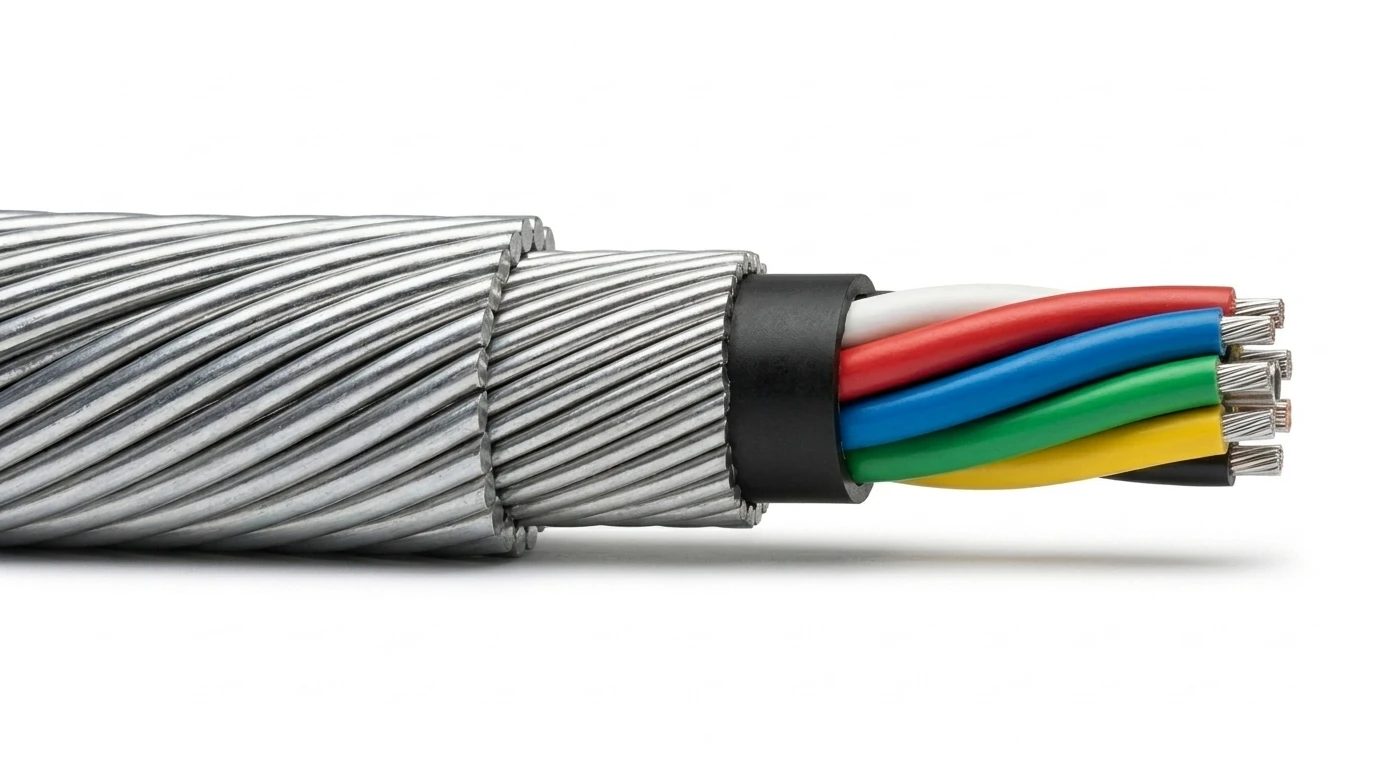
In open-hole oil, gas and deep geothermal wells, operators combine triple-combo or quad-combo formation evaluation suites, NMR sondes, rotary sidewall coring motors and downhole hydraulic fluid samplers on a single run. Seven-conductor heptacables (`7H37`, `7H42`, `7J46 / W7BPP-11.8` and `7H47 Slammer`) dominate this duty for three physical reasons:
- Geometric stability (`6+1` packing): Six equal-radius insulated cores tangent to an identical center core form nature’s tightest circular bundle—eliminating hollow crush voids under 100+ MPa mud column pressure.
- Orthogonal phantom telemetry: Driving symmetric opposing conductor pairs in differential phantom modes cancels capacitive coupling to the power conductors, pushing copper wireline telemetry up to 500–1,000 kbps over 6,000–7,500 m reels.
- High overpull margin for sticky open holes: Stepping from standard 11.80 mm `7J46` (76.5 kN MBL) to high-strength compacted/Slammer constructions (`7H47` at 109 kN, `W7PP-HS28-12.4` at 125 kN, or `W7PP-HS34-13.2` at 151 kN) provides critical fishing/overpull reserve across differential-sticking shale and deviated doglegs.
4. Armoured Electro-Optical FIMT Wireline: real-time DAS, DTS and borehole seismic

When a completion engineer needs continuous meter-by-meter Distributed Acoustic Sensing (DAS) during multi-stage hydraulic fracturing, high-resolution Distributed Temperature Sensing (DTS) across steam-assisted thermal wells, or multi-level 3C borehole seismic (VSP) arrays, copper skin-effect attenuation becomes a hard physics wall. Armoured FIMT fiber-optic and electro-optical wireline cables (`4SSA27` 6.60 mm optical-only, `FIMT-EO32` 8.18 mm `2C+4F`, and `FIMT-EO46` 11.80 mm `6C+6F`) hermetically enclose single-mode (`ITU-T G.652.D` / `G.657`) and multimode (`OM3` / `50/125 µm`) fibres inside a hydrogen-scavenging gel-filled stainless steel tube—fitting standard wellsite sheaves while unlocking gigabit optical telemetry.
Note that retrievable open-spool wireline FIMT cables differ from permanent tubing-clamped completions: for permanent outside-tubing installations, specify tubing-encased downhole cable (TEC); for subsea blowout-preventer and riser intervention control, specify subsea BOP MUX and IWOCS electro-optical umbilicals.
Matching insulation temperature class and armour metallurgy to bottom-hole conditions
Bottom-hole cable rating = Insulation thermal ceiling + Conductor plating stability + Armour H2S / chloride metallurgy
| Continuous temperature tier | Primary core insulation | Conductor stranding | Typical model suffix & well profile |
|---|---|---|---|
| Up to 135–150 °C (275–300 °F) | Modified polypropylene / polyolefin copolymer (PP / EPC) | Bare or tinned copper | 7H42RP, 7J46, W7BPP-11.8, 4H18RPP — standard oil, gas, coal & mineral wells |
| Up to 205–230 °C (400–446 °F) | Fluoropolymer FEP or cross-linked ETFE | Tinned or silver/nickel-coated copper | W7F46PP-11.8, 7RFTK, 7SFTK — deep HPHT gas & steam-flood wells |
| Up to 260 °C (500 °F) | Perfluoroalkoxy (PFA / MFA) + high-temp bedding | Nickel-coated copper (ASTM B 355) | Deep geothermal & supercritical HPHT (high-temperature wireline series; see high-temp insulation ratings) |
TEBAOFLEX custom-manufactures armoured monoconductor, 4-conductor quad, 7-conductor heptacable and FIMT electro-optical wireline logging cables from a 50 m minimum order length (up to continuous 6,000–10,000 m field drum lengths), with factory lead times of 7 to 45 working days. Explore our complete oil and gas cable range, review our oil and gas cable selection guide, or send your winch OD, bottom-hole temperature and toolstring telemetry spec for a factory quotation.
Questions
When should I choose a 7-conductor heptacable over a monoconductor wireline logging cable?
Select a 7-conductor heptacable (such as 7H42 at 10.82 mm or 7J46 / W7BPP-11.8 at 11.80 mm) for open-hole formation evaluation, rotary sidewall coring, acoustic imaging and high-power multi-sensor toolstrings requiring simultaneous AC/DC power plus orthogonal phantom telemetry up to 500–1,000 kbps. Use a monoconductor (5.6–8.2 mm) for cased-hole perforating, slick-e-line pressure/temperature gauges and gamma-CCL correlation runs through tight grease-injection lubricators.
What is a 4-conductor quad logging cable used for?
Four-conductor star-quad borehole cables (such as 4H18 at 4.72 mm and 4H25 / A240250 at 6.35 mm) are engineered for slim-hole mineral exploration (BQ, NQ and HQ diamond-drill rods), coal-seam geophysics, hydrogeology and geotechnical inclinometer/televiewer winches where drum capacity and portable tripod weight bar 11.8 mm oilfield heptacables.
Why do heptacable logging cables always use 7 conductors in a 6+1 geometry?
Six identical insulated outer conductors laid symmetrically around one central seventh conductor create a mechanically self-supporting circular core under high hydrostatic pressure and drum crushing, while enabling balanced orthogonal telemetry modes (such as Mode 5 and Mode 6 phantom pairs) with low crosstalk across 5,000 m to 9,000 m cable lengths.
When does a downhole logging unit require an electro-optical FIMT cable instead of copper heptacable?
Copper wireline attenuation limits practical telemetry to roughly 500 kbps–1 Mbps over 6,000–8,000 m. Switch to a stainless-steel Fiber-In-Metal-Tube (FIMT) armoured wireline cable (such as 6.60 mm 4SSA27 or 11.80 mm 6C+6F FIMT-EO46) whenever the run requires real-time Distributed Acoustic Sensing (DAS), Distributed Temperature Sensing (DTS), borehole seismic VSP arrays or uncompressed downhole optical video.
How do copolymer PP, fluoropolymer FEP/ETFE and PFA/MFA insulation grades change wireline temperature limits?
Modified polypropylene or polyolefin copolymer insulations cover standard wells up to 135–150 °C (275–300 °F). Fluorinated ethylene-propylene (FEP) and ETFE grades extend continuous service to 205–230 °C (400–446 °F), while perfluoroalkoxy (PFA/MFA) grades paired with nickel-plated copper conductors cover deep geothermal and HPHT wells up to 260 °C (500 °F).
What minimum order length and lead time apply to custom armoured wireline logging cables?
TEBAOFLEX manufactures monoconductor, 4-conductor quad, 7-conductor heptacable and electro-optical FIMT wireline logging cables from a 50 m minimum order length (with full continuous wellsite reel lengths up to 6,000–10,000 m by gauge), with production lead times of 7 to 45 working days.
When well monitoring shifts from retrievable open-hole wireline runs to permanent tubing-clamped completions across production packers, compare our 1/8 in and 1/4 in TEF, TEC-2C and PDHG tubing-encapsulated fiber-optic and dual-core downhole cables alongside our single-conductor 1/4 in TEC tubing-encased gauge cables.