

Cable reels, drums and vertical moving systems
Reeling Cable Solutions for Cranes and Mobile Equipment
Select reeling cable by reel geometry and duty. Compare random-winding, monospiral, level-wind, motorized, flat and vertical-spreader routes for LV, MV, control and fibre-optic systems.
- 0.6/1 kV and medium-voltage routes
- PUR, rubber, PCP, EPR and PVC options
- Round, flat, anti-torsion and self-supporting designs
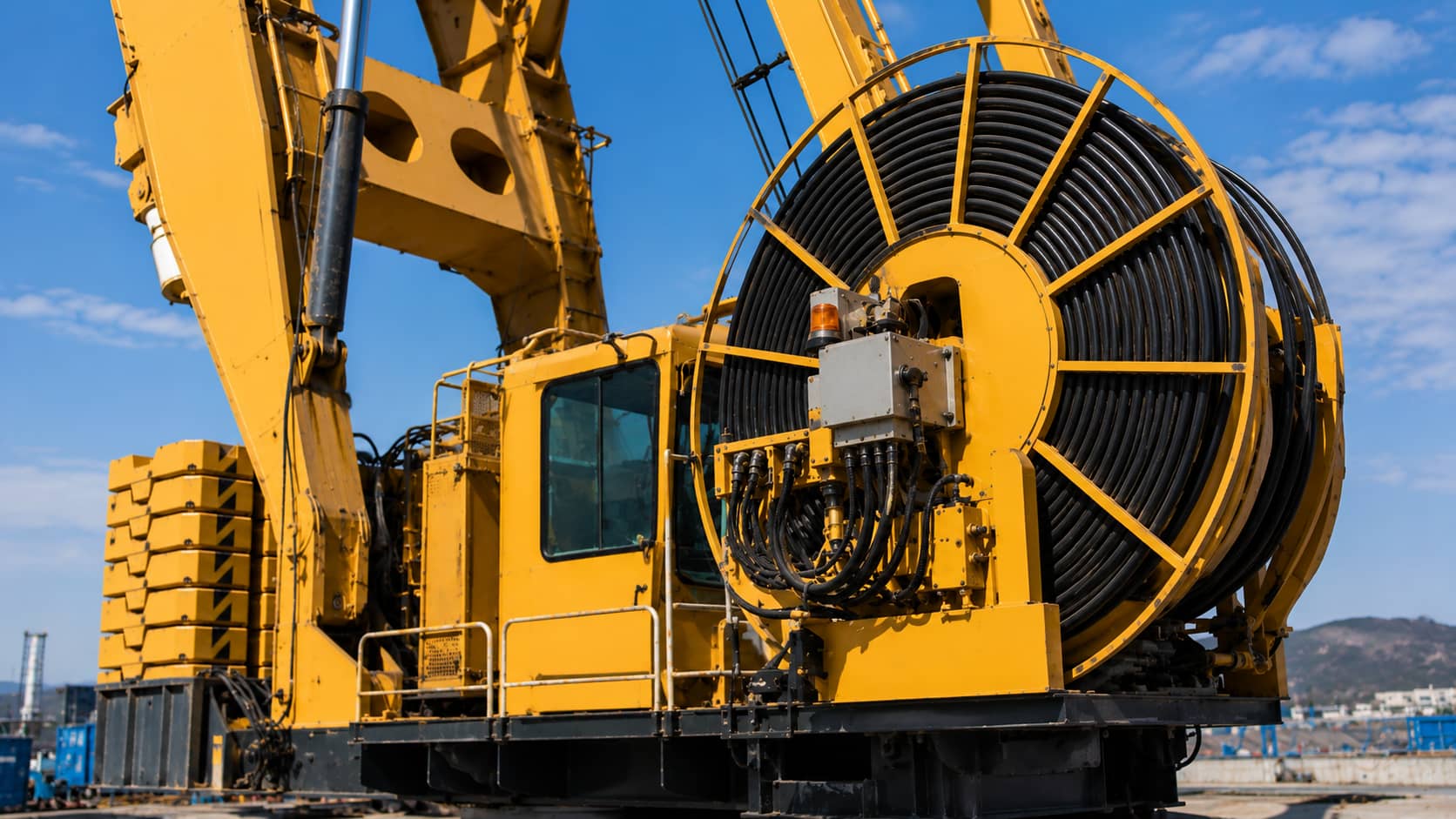
Start with five inputs that control cable life
A model name can identify a starting family, but the complete reel duty determines the construction that should be quoted.
1. Reel and winding pattern
Identify spring or motor drive, random winding, monospiral, level wind, single layer, multi-layer, horizontal travel or vertical payout.
2. Mechanical duty
Provide travel speed, acceleration, cycles, tensile load, hanging length, reel torque and any reverse-bend or S-guide arrangement.
3. Electrical system
Define voltage, conductor sizes, control cores, earth arrangement, screens, EMC needs and the number and type of optical fibres.
4. Cable geometry
Confirm round or flat construction, available drum space, cable guide width, drum core diameter and the smallest roller diameter.
5. Operating environment
State the dynamic temperature, UV, rain, salt, oil, grease, abrasion, mud, flame and impact exposure at the moving route.
Selection output
The review produces a cable-family route, preliminary construction, diameter and weight check, reel compatibility points and a quotation data list.
Choose the cable route by reel geometry
The same voltage can require very different cable mechanics when the winding pattern, tension and direction change.
Random-winding reels
Multi-layer winding creates crossover pressure and variable bending. GPM/GPM-RF, RP/RP-D and selected TRA constructions cover compact to heavy mobile duties.
View GPM and GPM-RF cableMonospiral reels
Cable stacks in one plane and the reel stays narrow. Confirm cable diameter, layer count, side pressure and the minimum reel diameter.
View RP and RP-D cableLevel-wind reels
A traverse guide lays the cable across the drum. Long travel and repeated direction changes make guide alignment, tension and torsion control critical.
View TRA anti-torsion cableMotorized high-speed reels
Acceleration and active torque control increase dynamic stress. RXP/RXP-D serves high-acceleration LV duty, while screened rubber routes serve MV systems.
View RXP and RXP-D cableFlat one-plane reels
A flat cable bends in one defined plane and can use drum space efficiently. Match cable height, width, guide geometry and optical-fibre requirements.
View NTSFLCGEWOEU flat cableVertical and spreader reels
The cable carries its own suspended weight while resisting rotation, wind and rapid direction changes. Tensile support and anti-torsion balance are primary selection inputs.
View vertical reeling cableCompare the 14 reeling cable families
Use the matrix to move from a model-family search to the closest TEBAOFLEX product route, then check the operating data in the next section.
| Family | Primary duty | Selection signal | TEBAOFLEX route |
|---|---|---|---|
| 02 GPM / GMP | LV PUR, random winding | General heavy-duty horizontal reeling | GPM / GPM-RF PUR cable |
| 03 RP / RP-D | Compact LV PUR | Random-winding or monospiral reel | RP / RP-D PUR cable |
| 04 RG / RG-D | LV rubber reeling | Monospiral or level-wind horizontal travel | NSHTOEU-J rubber cable |
| 05 WG / WG-D | MV PCP/rubber | Motorized reel at low to medium speed | R-(N)TSCGEWOEU cable |
| 06 WGF / WGF-D | MV flat EPR/rubber | One-plane reel and constrained drum width | NTSFLCGEWOEU flat cable |
| 07 C800 / 800 | Extra-flexible LV PVC | Compact spring or extension reel | C800 PVC reeling cable |
| 08 GPM-RF | Reinforced LV PUR | Higher tensile duty on random or monospiral reels | GPM / GPM-RF PUR cable |
| 09 RXP / RXP-D | Heavy LV PUR | High acceleration and motorized reeling | 12YHRDT11YH / RXP-D cable |
| 10 RXG / RXG-D | Heavy LV PCP/rubber | Motorized reel and repeated heavy movement | NSHTOEU-J rubber cable |
| 11 TRA | Anti-torsion LV PUR | Motorized, monospiral, random or level-wind reel | TRA anti-torsion cable |
| 12 HVR / HVR-D | Extra-heavy MV rubber | Motorized crane reel with optional fibre optics | (N)TSCGEWOEU MV crane cable |
| 13 WXG / WXG-D | High-speed MV PCP/rubber | Extra-heavy motorized reel and optical option | R-(N)TSCGEWOEU cable |
| 14 RXX | Extra-heavy LV vertical reel | High tensile load and rapid spreader movement | Spreader vertical cable |
| 15 TRA-RF | Anti-torsion LV vertical reel | Self-supporting spreader route | Spreader vertical cable |
Shortlist by voltage, speed, tensile duty and shape
These catalog operating envelopes provide a practical first filter. The RFQ then confirms conductor arrangement, reel geometry, dimensions and the exact moving duty.
| Operating need | Family route | Catalog speed signal | Construction focus |
|---|---|---|---|
| Compact LV spring reel | C800 | Up to 60 m/min | Extra-flexible transparent PVC; power, control or signal |
| General LV random winding | GPM / GPM-RF | Up to 60 / 90 m/min | PUR sheath with reinforced option |
| Compact LV random or monospiral | RP / RP-D | Up to 80 m/min | Compact PUR construction |
| LV rubber horizontal reel | RG / RG-D | Up to 120 m/min | Flexible rubber and tensile reinforcement |
| MV flat one-plane reel | WGF / WGF-D | Up to 120 m/min | Flat EPR/rubber with optional fibre optics |
| High-acceleration LV motor reel | RXP / RXP-D | Up to 180 m/min | Double PUR, support elements and braid |
| Anti-torsion multi-reel duty | TRA | Up to 200 m/min | Double PUR and anti-twist braid |
| Extra-heavy MV motor reel | HVR / HVR-D | Up to 180 m/min | Screened EPR MV system and reinforced rubber |
| High-speed MV motor reel | WXG / WXG-D | Up to 240 m/min | MV rubber/PCP route with optical options |
| Vertical spreader reel | RXX / TRA-RF | Up to 240 / 200 m/min | Self-supporting and anti-torsion construction |
Where these reeling cable routes are used
Reeling cable is an energy and signal link for moving machinery. The equipment changes, but the selection method remains tied to reel mechanics and the electrical system.
Port and container cranes
RTG, RMG, STS, trolley and auxiliary reels can combine LV or MV power, controls and fibre optics under outdoor salt, UV and high-cycle duty.
Open the port crane solutionSpreader and vertical hoisting
Vertical payout adds cable weight, wind and rotation to the bending cycle. RXX, TRA-RF and basket-cable routes address different support geometries.
Compare the 3GSLTOE basket routeStackers and reclaimers
Long travel, outdoor dust and stockyard contamination place sustained demands on reel torque, cable guide alignment, abrasion and MV screens.
Excavators and mobile mining equipment
Reeling and trailing duties need separate checks for haul-route damage, ground contact, torsion, MV protection and repair strategy.
Open the mining and tunnelling solutionConveyors, gantries and ship loaders
Travel length, start-stop frequency, drum position and cable support determine whether a compact LV, reinforced rubber or MV route is appropriate.
Automated power and data links
Hybrid reeling cables can integrate power, controls and fibre optics when fibre count, bend performance, termination and repair access are designed together.
View the MV 24FO cable routePrevent the failure modes that start at the reel
Most reeling problems are system problems. Cable construction, reel dimensions, torque, guidance and installation practice need to work as one moving assembly.
Repeated over-bending concentrates strain in conductors, screens and optical fibres. Confirm the drum core, guide rollers and every reverse bend.
Excess reel torque or vertical cable weight can stretch conductors and cores. State the actual pulling force and suspended length.
Misaligned guides, unsuitable winding patterns or rotation in a vertical route can disturb the cable lay. Use anti-torsion and support features where the duty requires them.
Random winding creates crossover and side pressure. Check drum fill, cable diameter, tension and sheath resistance together.
Dynamic bending affects conductor screens, insulation screens and earth arrangements. Define the voltage system, protection and termination interfaces before manufacture.
Cable stored on a drum dissipates heat differently from cable paid out in free air. Provide the loaded length, duty cycle and winding state used for current calculation.
Standards and test references to define in the RFQ
The applicable construction and tests depend on the voltage class, cable family and project specification. These current IEC references are useful anchors for the agreed inspection plan.
Conductors
IEC 60228:2023 covers conductor sizes, wire construction and resistance requirements, including flexible copper conductors.
Single-cable flame test
IEC 60332-1-2:2025 defines the 1 kW pre-mixed-flame procedure for vertical flame propagation on a single cable.
1 kV and 3 kV power cable reference
IEC 60502-1:2021 provides construction, dimensions and test requirements for covered voltage classes and fixed-installation power cables.
6 kV to 30 kV power cable reference
IEC 60502-2:2014+AMD1:2024 CSV, including the 2026 corrigendum, is a current reference for covered MV cable construction and tests.
From reel data to an agreed cable schedule
A short engineering sequence keeps the moving system, electrical construction and delivery documents aligned.
Map the moving system
Review equipment, reel type, winding pattern, route drawing, travel, speed, tension, bends and environment.
Select the family route
Compare voltage, geometry, sheath, reinforcement, anti-torsion needs and fibre-optic integration.
Confirm the cable schedule
Agree cores, screens, dimensions, weight, marking, length, drum, termination interfaces, tests and documents.
Manufacture and inspect
Production, routine tests, agreed witness points, packing and release documents follow the confirmed order schedule.
Cross-reference by original model name
Buyers often send a manufacturer’s model name or part number instead of a cable specification. These pages compare the original catalogue data with a TEBAOFLEX construction. The names are trademarks of their owners, and TEBAOFLEX is not affiliated with them.
Reeling cable selection questions
Use these answers to prepare the first technical review.
What is the difference between reeling cable and ordinary flexible cable?
Reeling cable is built for repeated winding and unwinding under controlled bending, tension and often torsion. An ordinary flexible cable may not have the conductor lay, reinforcement, sheath or screen stability needed for a powered reel.
How do random-winding and monospiral reels change cable selection?
Random winding places cable in multiple crossover layers and creates variable side pressure. A monospiral reel stacks the cable in one plane, so cable diameter, layer geometry and side guidance become especially important.
When is an anti-torsion reeling cable needed?
Anti-torsion construction is useful when the route can rotate the cable, when direction changes accumulate twist, or when a vertical moving cable must remain stable. Reel and guide alignment still need to be checked.
Can power, control and fibre optics be combined in one reeling cable?
Yes, when the conductor arrangement, screens, optical elements, bend performance, tensile support, termination and repair strategy are engineered as one hybrid construction.
What information is needed to quote a crane reeling cable?
Provide the electrical schedule, reel type, winding pattern, drum and roller diameters, travel, speed, acceleration, tension, hanging length, environment, length, quantity and required tests or documents.
Send the reel data that makes the quotation useful
Share whatever is available now, including old cable markings, equipment drawings, reel drawings and the project specification.
- Equipment and route: crane, spreader, stacker-reclaimer, excavator, conveyor, gantry or ship loader
- Reel: spring or motorized, random, monospiral, level wind, single layer, multi-layer or vertical
- Voltage, frequency, conductor sizes, power cores, control cores, earths, screens and fibre count
- Travel length, cable length, speed, acceleration, cycles and operating time
- Drum core diameter, drum width, layer count, guide rollers and smallest reverse bend
- Reel torque, tensile load, hanging height, cable support method and allowable cable weight
- Dynamic and storage temperatures, UV, salt, oil, grease, water, abrasion, flame and impact exposure
- Model reference, standard, test plan, inspection, marking, length, quantity, drum and delivery documents