


Fixed mine distribution routes
Armoured mining cable is built for routes that stay put: mine distribution, substation feeders, shaft risers and roadway supplies. It is not a trailing or reeling cable with armour added, and its armour is not the rigid steel wire armour used in building installations. Both differences change what you can specify and how the cable behaves.
Armoured and static mining cable at a glance
- Static mining cable
- A cable that stays in a fixed position for its service life. It is clipped, cleated, suspended or buried, and is not dragged, reeled or flexed by moving equipment.
- Armoured mining cable
- A mining cable carrying a metallic armour layer for mechanical protection, most often over a fixed or semi-fixed route. Armour is a mechanical element and is not a substitute for the screen or the earth conductor.
- Pliable armour
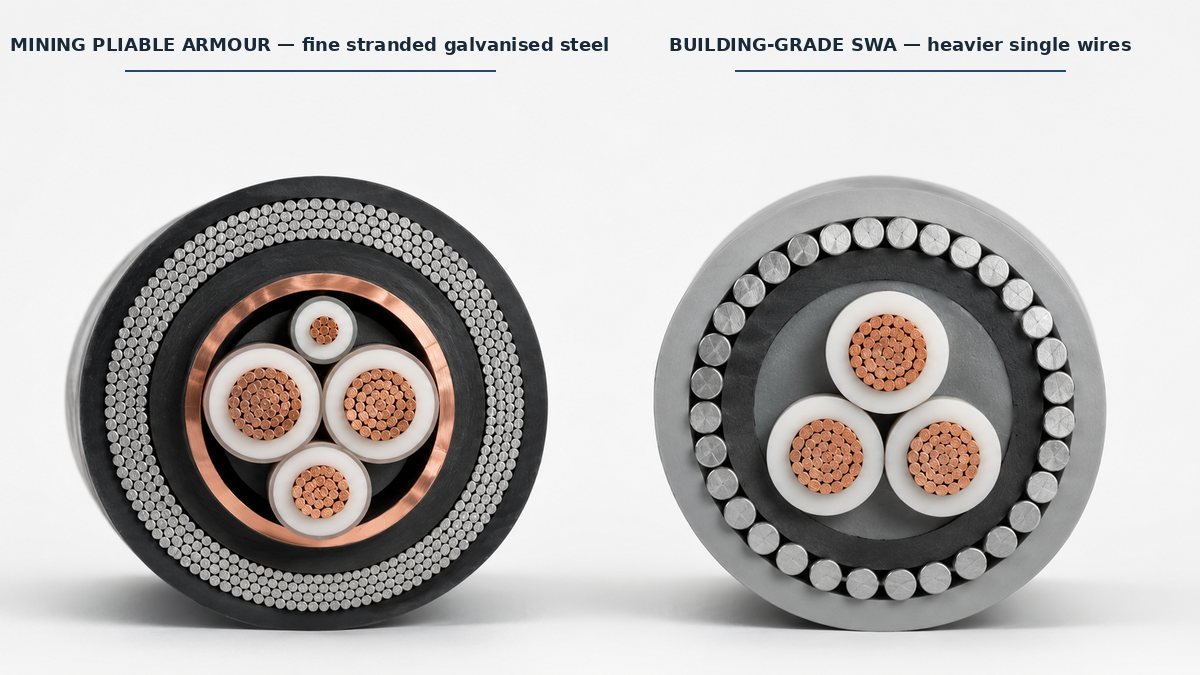
- Galvanised steel wires or strands laid so the cable retains handling flexibility. This is the mining convention and differs from the rigid single-wire armour used in building cable.
- Pilot core
- An additional insulated conductor used to prove the earth path and to trip supply if continuity is lost. Common in Australian mining constructions.
- Typical voltage range
- 1.1 kV for equipment supplies, 3.3 to 11 kV for reticulation and substation feeders, up to 15 kV for high-voltage distribution.
- What it is not
- Not a trailing cable, not a reeling cable, and not building-grade SWA. Each is a different construction with different acceptance rules.
What “static” actually means in a mine
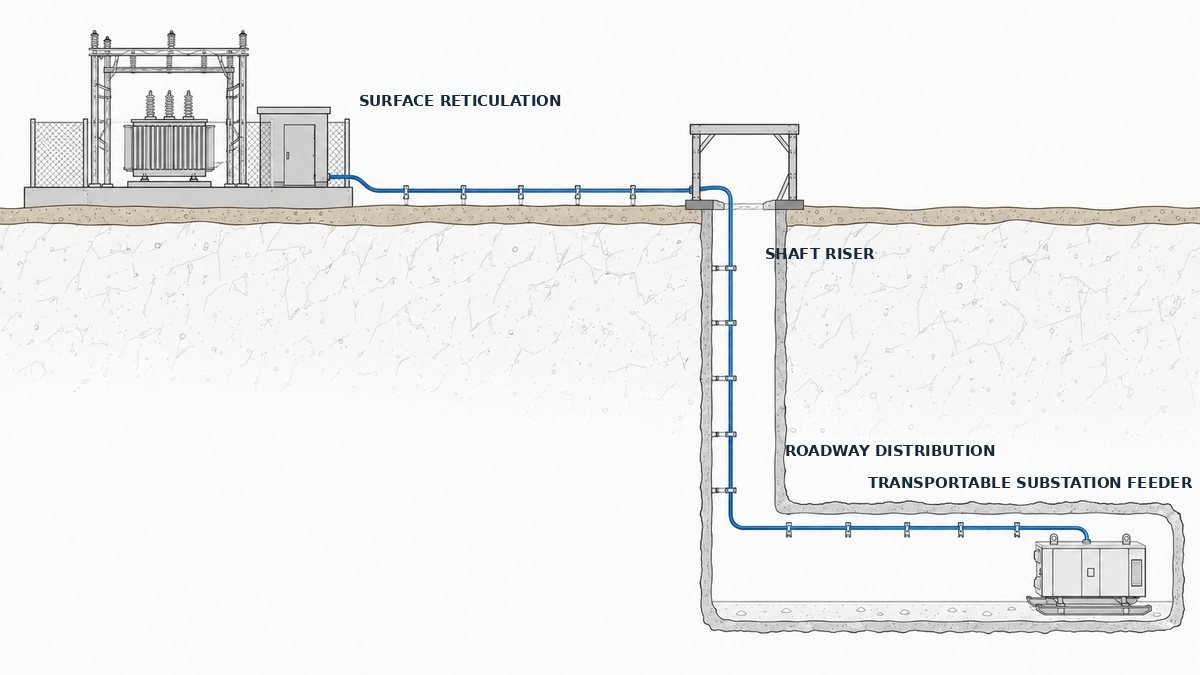
Static in a mining cable schedule is a duty class, not a description of stiffness. A static cable occupies one position for its service life: fixed to a roadway rib, cleated along a shaft, laid in a trench, or run to a transportable substation that is repositioned only a few times a year.
The distinction matters because it changes the whole specification. A static route removes the flexing life requirement that dominates trailing and reeling design, and replaces it with different priorities: mechanical protection from roof fall and vehicle impact, resistance to crush over long unsupported spans, and an earth path that survives the life of the installation.
The naming trap. In longwall practice the phrase static cable also describes the fixed control and monitoring cables that lie on the goaf side of the face, linking control units at stations along the face. Both meanings are in daily use. Confirm which one a specification means before quoting, because one is a power construction and the other is a control construction.
Why mining armour is pliable, not rigid
Building-grade steel wire armour uses relatively heavy single wires laid tightly over a bedding layer. The result is stiff, which is acceptable in a wall or duct where the cable is installed once and never touched again.
Mining armoured constructions use pliable armour: galvanised low-carbon steel wires or strands laid so the cable can still be pulled around a corner, coiled for transport and repositioned when a face advances. The mechanical protection is real, but the cable is not the rigid product an electrician would recognise from a building site.
| Property | Mining pliable armour | Building-grade SWA |
|---|---|---|
| Armour form | Fine galvanised steel wires or stranded groups | Heavier single galvanised wires |
| Handling | Can be coiled, pulled and repositioned | Installed once, effectively fixed |
| Bending radius | Tighter, suited to roadway and shaft routing | Wider, suited to trays and ducts |
| Typical insulation | EPR or equivalent elastomer | XLPE |
| Typical sheath | PCP or heavy-duty elastomer | PVC or LSZH |
| Earth arrangement | Screen plus pilot or ground-check core | Armour commonly used as the earth |
The last row is the one that causes site problems. In many building installations the armour itself is the circuit protective conductor. In mining constructions the earth path is normally a dedicated screen, earth conductor or pilot arrangement, and the armour is mechanical. Do not assume the armour is the earth.
Where fixed armoured mining cable actually runs
| Route | What dominates the choice | Typical arrangement |
|---|---|---|
| Surface to portal reticulation | Direct burial, vehicle crossings, excavation risk | Armoured MV feeder, 3.3 to 11 kV |
| Shaft riser | Self-weight over vertical span, cleating intervals, water | Armoured MV with tensile capability, cleated at intervals |
| Roadway distribution | Roof fall, vehicle impact, rib rub | Armoured or heavily sheathed MV, clipped high on the rib |
| Transportable substation feeder | Repositioned a few times a year, not continuously moved | Pliable armoured feeder, coiled for each move |
| Fixed plant and conveyor drives | Long unsupported spans, fixed terminations | Armoured LV or MV, sized for voltage drop over distance |
| Face control and monitoring | Signal integrity, segregation from power | Screened control construction, not a power cable |
Voltage drop deserves separate attention on fixed routes. Trailing cables are usually short and the limit is mechanical. Fixed reticulation can run for hundreds of metres, and conductor size is often set by voltage drop and fault duty rather than by current alone.
Pilot cores and earth continuity on fixed routes
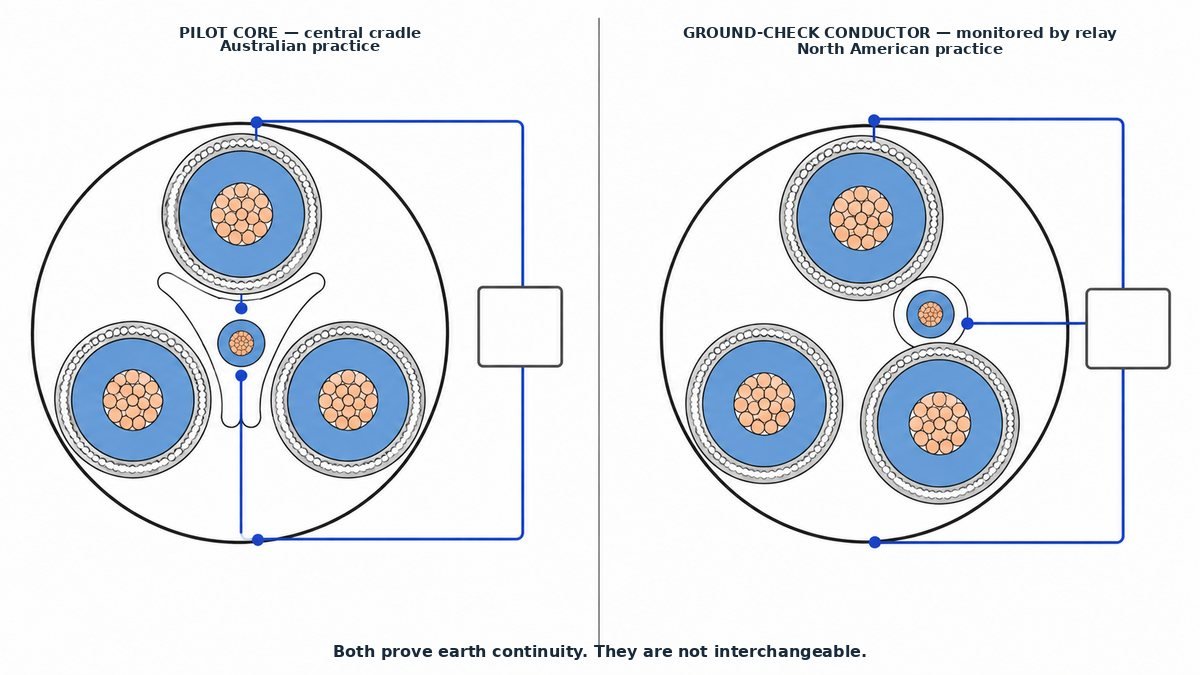
An armoured feeder still needs a provable earth path. Two arrangements dominate, and they are not interchangeable.
- Pilot core. An insulated conductor, often laid interstitially or on a central cradle, used to prove earth continuity and trip the supply if it is lost. Common in Australian constructions such as Type 260.
- Ground-check conductor. A separate conductor monitored by a ground-check relay, used in North American practice and required on many underground high-voltage circuits.
Both exist because a fixed route can develop an earth fault that nobody sees for months. On a trailing cable, damage is usually obvious. On a buried or cleated feeder it is not, so the monitoring is built into the cable rather than left to inspection.
Which standard governs a fixed armoured mining cable
Fixed mining constructions are specified under regional standards rather than one international document. State the standard in the enquiry; it changes the construction, not just the paperwork.
| Region | Standard reference | Where it applies |
|---|---|---|
| Australia and New Zealand | AS/NZS 1802 | Underground coal trailing and reeling constructions, and the armoured feeder families derived from them |
| Australia and New Zealand | AS/NZS 2802 | Reeling and adjacent mining constructions outside coal |
| North America | ICEA S-75-381 with MSHA acceptance | Mine power feeder and portable power constructions, including ground-check arrangements |
| Germany and EU | DIN VDE 0250 series | Tunnel and mine power constructions in the European designation system |
| South Africa | SANS 1520 series | South African mining constructions |
Standards names are selection references, not an approval claim. Confirm the edition, the acceptance route and the required test documents for the jurisdiction before the order is released.
When the route is not static after all
Specifying an armoured construction for a cable that will actually be dragged is the most expensive mistake in this category. Armour wires fatigue and break under repeated flexing, and the broken ends can migrate through the bedding. If any part of the route moves with equipment, use a mobile construction instead.
- Reeling cable versus trailing cable — decide the movement duty before the construction.
- Abrasion-resistant cable for mobile equipment — jacket compounds, wear mechanisms and how to read a worn sheath.
- Mining cable selection guide — the eight-step method for mobile equipment circuits.
- Medium-voltage mining cable selection — screens, grounding and reel data for MV mobile routes.
- SHD-GC, Type G-GC and Type W compared — the North American portable families.
- Type 209 selection notes — the Australian portable family by voltage.
Information required for a fixed armoured cable enquiry
| Data group | Minimum information | Why it matters |
|---|---|---|
| Duty | Confirm the route is fixed, and state how often a transportable substation is repositioned | Decides whether an armoured construction is appropriate at all |
| Electrical | System voltage, load, earthing system, fault level and clearing time | Sets voltage class, screen and earth arrangement |
| Route | Length, buried or cleated, vertical span, crossings and ambient conditions | Sets armour, sheath and tensile requirements |
| Earth path | Pilot core or ground-check conductor, and the relay it must work with | The two arrangements are not interchangeable |
| Compliance | Governing standard, edition and required test or acceptance documents | Changes the construction, not only the paperwork |
| Delivery | Drum lengths, jointing positions, marking and packaging | Fixed routes are cut to length; joints must be planned before manufacture |
Questions buyers ask
What is an armoured mining cable?
An armoured mining cable is a mining power cable carrying a metallic armour layer for mechanical protection, normally used on fixed or semi-fixed underground and surface routes. The armour resists crushing, impact and excavation damage, and sits over a bedding layer beneath the outer sheath.
What is a static mining cable?
A static mining cable occupies one position for its service life rather than being dragged or reeled by moving equipment. Typical static routes include surface reticulation, shaft risers, roadway distribution and feeders to transportable substations that are repositioned only occasionally.
Can an armoured cable be used as a trailing cable?
No. Armour wires fatigue and break under the repeated flexing a trailing route imposes, and broken wire ends can migrate through the cable. Specify a purpose-built trailing or reeling construction wherever any part of the route moves with the equipment during operation.
Is the armour the earth conductor in a mining cable?
The armour is not normally the earth conductor in a mining cable. The earth path is usually a dedicated screen, earth conductor or pilot arrangement, and the armour is a mechanical element. This differs from many building installations where the armour is the circuit protective conductor, so do not carry that assumption into a mine.
What is the difference between a pilot core and a ground-check conductor?
Both prove earth continuity, but they belong to different practices. A pilot core is common in Australian constructions and is often laid interstitially or on a central cradle. A ground-check conductor is monitored by a ground-check relay and is standard in North American underground practice.
What voltage range do armoured mining cables cover?
Armoured mining constructions are commonly supplied from 1.1 kV for equipment supplies, through 3.3, 6.6 and 11 kV for reticulation and substation feeders, and up to 15 kV for high-voltage mine distribution. The exact range depends on the governing regional standard.
Fixed and armoured mining cable routes
- Type 260 armoured screened mining power cable — pliable armoured construction to AS/NZS 1802, 1.1 to 11 kV, for coal-mine supply and mine distribution.
- Type 412 armoured mining power cable — 1.1 kV armoured construction to AS/NZS 2802 for heavy-duty equipment supply.
- Type MP-GC 15 kV mine power feeder cable — three-conductor ground-check feeder for fixed high-voltage distribution in mines, tunnels and shafts.
- 2XSEYQY 6/10 kV MV tunnel power cable — the European designation route for tunnel and mine power.
- Mining, drilling and tunnelling cables — the full range with a selection table by movement duty.
Source and review status
Construction descriptions reflect published manufacturer and distributor data for cables built to the standards named above, together with the product records for the TEBAOFLEX constructions linked on this page. Standard references are given as selection references and should be confirmed against the current edition for the governing jurisdiction. Reviewed 3 September 2026.
Send the route, not just the cable type
State whether the route is fixed, the system voltage, the earth arrangement and the drum lengths you need. TEBAOFLEX can use them as the starting point for a project-specific mine cable review.