









Reeling cable
To select a reeling cable, start from the reel and not from the voltage. Identify the reel type, keep working tension within 15 N/mm² of copper unless the cable maker agrees a higher figure, size the drum and rollers from the cable diameter, confirm the speed, and derate the current for the wound layers. Voltage and conductor size only tell you which cable family to look in. The Port Equipment Manufacturers Association (PEMA), in its 2019 paper on container crane cables, lists excessive tension, bends below the minimum radius, twist from misaligned guides and overheating among the typical cable problems, and each of those depends on the reel as much as on the cable.
Which reel type are you selecting for?
The reel type comes first because it decides how the cable bends, how far the wound diameter changes and how well the cable sheds heat. There are three winding patterns, and vertical systems behave differently again.
| Reel type | How the cable lies | What it means for the cable |
|---|---|---|
| Monospiral | One turn per layer, stacked between closely spaced flanges | The preferred type on modern cranes, according to PEMA. The route is simple and heat escapes more easily, but the wound diameter changes a lot, and tension and reel speed change with it. Takes round or flat cable. |
| Cylindrical (level wind or multi-layer) | Turns side by side across a wide drum, in one layer or several | Holds long lengths and large cables at steadier tension. Each extra layer traps more heat, and the guides add changes of direction. |
| Random wound | No guide, so turns cross each other | The simplest reel, with the risk of slipping coils, sudden tension, torsion and abrasion. Prysmian’s Panzerflex catalogue limits it to small cables, about 250 m and under about 4 kg/m. |
| Vertical or basket | The cable hangs from the reel or falls into a basket | The cable carries its own weight and can rotate, so support and anti-torsion elements matter. PEMA gives a radius of 15 × diameter for basket duty. |
A cable listed for one pattern is not automatically suitable for another, so name the reel type in any enquiry. Our reeling cable solutions page maps each reel type to a cable family, and this guide covers the checks behind that choice. If the cable drags along the ground and does not wind on a drum, the duty is different, as our comparison of reeling and trailing cable explains for mining machines.
How much tension can a reeling cable take?
The usual limit is 15 N/mm² of copper. IEC 60204-1 clause 12.6.2 says the tensile stress on copper conductors shall not exceed 15 N/mm² of the copper cross-section. Above that it calls for cables with special construction features and a stress agreed with the cable manufacturer. PEMA gives the same 15 N/mm² on the main-core cross-section, citing DIN VDE 0298-3 section 7.1, and adds that under variable loads such as reeling, the permissible tension and fatigue life should be agreed between the design engineer and the cable manufacturer. The 50 N/mm² in the same paper applies to flexible cables under static stress during installation and is not a running tension.
IEC 60204-1 covers machine equipment up to 1,000 V AC, and it points to IEC 60204-32 for hoisting machines and IEC 60204-11 for higher voltages. If your project names one of those parts, check the clause in that part.
Allowable pull in newtons ≈ 15 × cross-section of the phase conductors in mm²
Counting only the phase conductors is the cautious reading, and it follows PEMA’s wording. The table applies it to three builds from our own orders, with the overall diameter measured on the finished cable: two sizes from a stacker-reclaimer order and one from a bucket-wheel excavator order.
| Build | Measured overall diameter | Phase copper | Pull at 15 N/mm² |
|---|---|---|---|
| (N)SHTÖU-J 3×70+3×35/3, 0.6/1 kV | 44.45 mm | 210 mm² | 3,150 N |
| (N)SHTÖU-J 3×185+3×95/3, 0.6/1 kV | 63.23 mm | 555 mm² | 8,325 N |
| (N)TSCGECEWÖU 3×35+3×25/3, 12/20 kV | 60.57 mm | 105 mm² | 1,575 N |
Reinforced constructions can be rated higher, and the figure then comes from the data sheet of that exact cable.
Several forces share the allowance. IEC 60204-1 names acceleration, speed, hanging weight, the method of guiding and the design of the drum system. Take the 3×70 cable at about 3.74 kg/m. A 20 m vertical drop adds 3.74 × 9.81 × 20, about 734 N. Accelerating 200 m of wound cable, 748 kg, at 0.5 m/s² takes up to about 374 N, before the inertia of the drum itself.
Why tension peaks when the reel is nearly empty
On a monospiral reel the radius changes as the cable winds. With a constant reel torque, tension equals torque divided by radius, so the pull is highest at the barrel, when almost all the cable is paid out. The full diameter follows from the barrel diameter, the cable diameter d and the wound length L:
Full reel diameter = √(barrel diameter² + 4 × d × L ÷ π)
| Barrel diameter | Full reel diameter | Turns | Reel speed, full reel | Reel speed, at barrel | Pull at barrel |
|---|---|---|---|---|---|
| 0.8 m | 3.46 m | 30 | 11.0 rpm | 47.7 rpm | about 2,160 N |
| 1.2 m | 3.57 m | 27 | 10.7 rpm | 31.8 rpm | about 1,490 N |
| 1.6 m | 3.73 m | 24 | 10.3 rpm | 23.9 rpm | about 1,160 N |
All three barrels clear the minimum for this cable, yet the smallest turns a 500 N setting into about 2,160 N at the barrel, most of the 3,150 N allowance before hanging weight or acceleration is added. A larger barrel costs little in overall size: going from 0.8 m to 1.6 m adds only about 0.27 m to the full reel. The length, speed and torque here are illustrative. A drive that adjusts torque as the diameter changes will flatten this effect, so ask the reel maker how the reel is controlled and for the real pull at the barrel.
How large must the drum and rollers be?
Multiply the overall cable diameter by the factor for that part of the route to get the minimum radius, then double it to get the barrel or roller diameter. Our guide to cable bending radius explains that convention. For reeling, the factor depends on the part of the route, the cable diameter and the voltage, and the two published tables below do not agree in every cell.
| Part of the route | IEC, d ≤ 8 mm | IEC, 8 to 20 mm | IEC, d > 20 mm | PEMA, to 1 kV, to 20 mm | PEMA, to 1 kV, over 20 mm | PEMA, over 1 kV |
|---|---|---|---|---|---|---|
| Cable drum or reel | 6 | 6 | 8 | 5 | 6 | 12 |
| Guide roller or pulley | 6 | 8 | 8 | 7.5 | 7.5 | 15 |
| Festoon | 6 | 6 | 8 | 4 | 5 | 10 |
| Basket | — | — | — | 15 | 15 | — |
| Delivery drum | — | — | — | 5 | 6 | 7 |
Both tables defer to the cable maker. IEC allows other values only when they are agreed with the cable manufacturer, taking tension and fatigue life into account, and PEMA says the supplier’s minimum radius should be followed. Cables with optical fibres need larger radii. Data sheets for German-designation cables usually refer to DIN VDE 0298-3, and our NSHTÖU-J data lists 5 × or 6 × diameter on drums and 7.5 × on guide pulleys.
| Build | Barrel diameter | Roller diameter |
|---|---|---|
| 3×70+3×35/3, 0.6/1 kV, 44.45 mm | 534 mm at 6 × D, 712 mm at 8 × D | 667 mm at 7.5 × D, 712 mm at 8 × D |
| 3×185+3×95/3, 0.6/1 kV, 63.23 mm | 759 mm at 6 × D, 1,012 mm at 8 × D | 949 mm at 7.5 × D, 1,012 mm at 8 × D |
| 3×35+3×25/3, 12/20 kV, 60.57 mm | 1,454 mm at 12 × D | 1,818 mm at 15 × D |
Compare the last two rows. The 12/20 kV cable is slightly thinner than the 3×185 cable, yet at PEMA’s figures it needs about 1.9 times the barrel, and with about a fifth of the phase copper it has about a fifth of the pull. A medium-voltage cable therefore cannot simply replace a low-voltage cable of the same diameter on an existing reel.
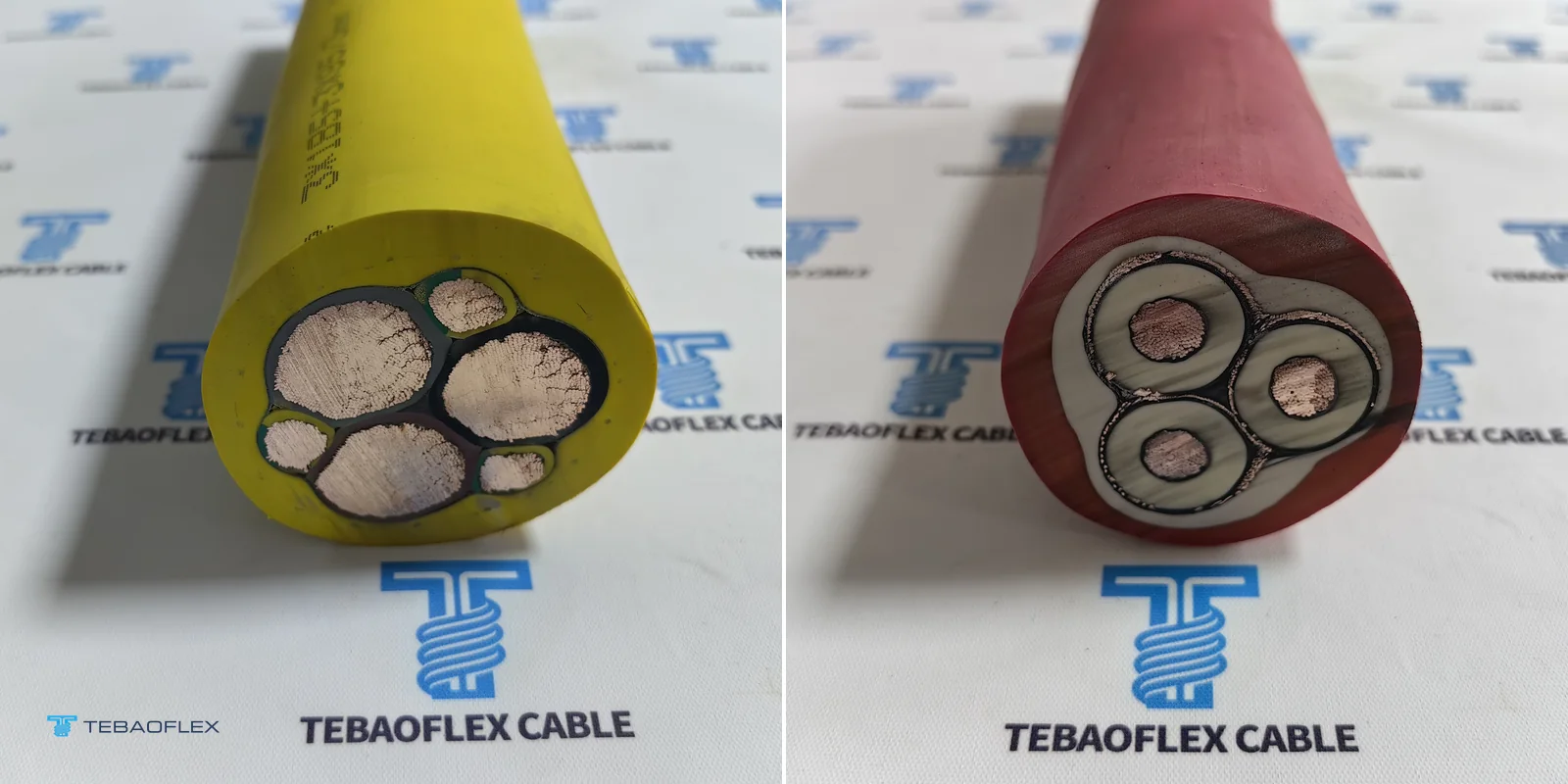
Use the largest diameter on the data sheet, or measure the cable. A caliper reading on old cable can mislead, as our guide to replacing aged reeling cable shows. Meeting the minimum does not set the service life either: IEC 60204-1 warns that life falls where high tensile stress, small radii, bending into another plane and frequent duty cycles coincide.
How fast can a reeling cable run?
The limit belongs to the exact cable and the reel, and PEMA leaves it to the cable manufacturer. It notes that applications beyond 240 m/min may need special design features, and that flat reeling cables should not exceed a gantry speed of 120 m/min. Its layout sketches restrict reverse-bend arrangements to low speed, at most 60 m/min, with at least 3 m between the bends.
Travel speed is not reel speed. Reel speed in rpm is the travel speed divided by π × the wound diameter, so in the table above 120 m/min means about 11 rpm on the full reel and 47.7 rpm at a 0.8 m barrel. The drive has to cover that whole range, and it has to do so at the acceleration the machine uses. Give the acceleration as well as the top speed, because the same tension allowance has to cover it.
On a centre-fed route the reel stops and reverses as the machine passes the feed point. The Panzerflex catalogue recommends a travel speed reduction device as its main measure for limiting dynamic stress, slowing the machine before the centre point and accelerating again after the reel has reversed. It also recommends both over-tension and under-tension protection: a short over-tension can permanently deform the conductors, and too little tension lets the cable free-spool, a particular concern on high-mounted reels.
How much current does a wound cable lose?
A wound cable cannot shed heat as it does in free air, so its current rating falls with the way it sits on the drum. IEC 60204-1 clause 12.6.3 requires conductors sized so that, fully wound and carrying the normal service load, the cable stays within its maximum conductor temperature. Its Table 7 gives the factors to apply to the free-air rating.
| Drum type | Layers | Factor | 300 A becomes |
|---|---|---|---|
| Radial, ventilated | Any number | 0.85 | 255 A |
| Radial, not ventilated | Any number | 0.75 | 225 A |
| Cylindrical, ventilated | 1 | 0.85 | 255 A |
| Cylindrical, ventilated | 2 | 0.65 | 195 A |
| Cylindrical, ventilated | 3 | 0.45 | 135 A |
| Cylindrical, ventilated | 4 | 0.35 | 105 A |
In the standard’s terms, a radial drum holds spiral layers between closely spaced flanges, which is a monospiral reel: solid flanges make it non-ventilated, and flanges with suitable apertures make it ventilated. A ventilated cylinder drum has widely spaced flanges, with apertures in the drum and end flanges. Take the real free-air rating from the data sheet or the national standard.
IEC recommends discussing these factors with the cable and drum makers, because that can lead to other values. The Panzerflex catalogue, for example, lists 0.80, 0.61, 0.49 and 0.42 for one to four layers, so use the factors that belong to the actual cable. PEMA adds that the reel type can bring its own derating, which may or may not include ambient temperature, and that flat cables need special attention to cooling. Send the load together with the winding state, because a machine that draws full power only when most of the cable is paid out is a different thermal case from one that runs at full power on a full reel.
Which cable construction fits the duty?
Once the reel data is fixed, the construction follows from the load, the speed and the environment. IEC 60204-1 requires Class 5 or Class 6 conductors for flexible cables. PEMA describes low-voltage reeling cables as based mainly on polyurethane or synthetic rubber, and medium-voltage cables more often on synthetic rubber. Synthetic rubber has the advantage at high speed, while polyurethane cables are usually thinner and lighter, which allows a lighter reel.
Inside the cable, splitting the earth conductor into the interstices between the power cores, as in 3×50+3×25/3, gives a smaller diameter and more flexibility. PEMA asks for an earth of at least half the cross-section of one power conductor, or whatever local rules require. It recommends no more than 24 fibres where fibre optics are integrated into the power cable, and it warns that fine copper wires in a braid or screen can work-harden and rub against each other, so check the radius and speed for any screened cable. The table lists the speeds stated for our main reeling families.
| Reel duty | Cable family | Stated travel speed |
|---|---|---|
| Compact spring reel, low voltage | C800 PVC | Up to 60 m/min |
| General random or monospiral reel, low voltage | GPM / GPM-RF PUR | Up to 60 / 90 m/min |
| Compact random or monospiral reel, low voltage | RP / RP-D PUR | Up to 80 m/min |
| Horizontal reel, low-voltage rubber | NSHTÖU rubber | Up to 120 m/min |
| High-acceleration motor reel, low voltage | RXP-D PUR | Up to 180 m/min |
| Anti-torsion duty on several reel types, low voltage | TRA PUR | Up to 200 m/min |
| Vertical spreader reel, low voltage | RXX / TRA-RF | Up to 240 / 200 m/min |
| Motor crane reel, up to 12/20 kV | (N)TSCGEWÖU rubber | Up to 180 m/min |
Stated speeds are upper limits and do not replace a check of the complete route. The same checks apply in mining: an underground loader reel uses a low-voltage cable such as NSHTOEU LHD loader cable, where ground contact adds its own abrasion risk.
What keeps a reeling cable from twisting?
Twist comes from the route and the installation. The Panzerflex catalogue puts it plainly: a correctly installed cable does not twist unless guides or unnatural bends introduce torsion. IEC 60204-1 clause 13.4.3 sets three route limits, and PEMA adds rules for anchoring and laying the cable.
- Lateral angle. Keep it within 5° where the cable winds on and off the drum and where it approaches and leaves a guide.
- Turns on the drum. Make sure at least two turns always remain on the drum.
- Straight sections. Leave at least 20 × the cable diameter between two bends, so the cable can recover before it bends again. Avoid reverse bends where you can: our medium-voltage crane cable data lists 20 × diameter for S-type direction changes.
- Tension relief. PEMA says a moving reel cable should never run without sufficient tension relief, from a relief drum or a mesh grip. A relief drum needs at least two full windings, and the distance to the entry funnel comes from the cable maker. The Panzerflex catalogue suggests spreading a grip over 20 to 25 × the cable diameter.
- Laying the cable. Feed it directly from the delivery drum onto the reel in one continuous run under constant tension, with both drums turning in the same direction and the same plane, so no reverse bend enters the cable.
- The first check. Draw lines along the cable and run the machine. If they start to spiral, stop and find the external cause. A slight spiral in the printed marking on long lengths is normal, according to the same catalogue, and is not a twist.
What should you send for a reeling cable check?
A useful check needs the reel, the route and the load together. These are the details to include for a new reel or a replacement:
- The reel: type, drive, barrel and flange diameter, drum width, torque or pull setting, and the number of layers.
- The route: travel length, feed point, guide and roller diameters, reverse bends, lateral angles, and any hanging length.
- The motion: top speed, acceleration, cycles per day, and whether the reel is horizontal or vertical.
- The load: voltage, current, duty cycle, the winding state at full load, conductor and earth arrangement, and any control cores or fibres.
- The site: lowest and highest temperature, sunlight, salt, oil, water and ground contact.
With these figures the cable can be checked against your reel and not against a catalogue value. As of August 2026, the minimum order is 50 m for standard and customised constructions alike, and lead time runs from 7 to 45 working days depending on product type, stock position and customisation. Send your cable specification for review.
Questions
What is the maximum tension on a reeling cable?
The usual limit is 15 N/mm² of copper cross-section, from IEC 60204-1 and DIN VDE 0298-3. A 3×70 mm² cable therefore has about 3,150 N. Above that limit, use a cable with special construction features and agree the figure with the manufacturer.
How do I work out the minimum drum diameter?
Multiply the largest cable diameter by the reel factor, then double it. The factor is 5 to 8 up to 1 kV, depending on the diameter and the table used, and 12 over 1 kV. A 44.45 mm low-voltage cable at 6 × diameter needs a barrel of at least 534 mm.
What is the difference between a monospiral and a level wind reel?
A monospiral reel stacks one turn on top of another between close flanges, so it stays narrow but its diameter changes a lot. A level wind reel uses a traversing guide to lay turns side by side across a wide drum, so it suits longer travel and has a steadier diameter.
Why is the current rating lower on a reel?
The current rating is lower on a reel because a wound cable cannot shed heat as it does in free air. IEC 60204-1 applies 0.85 or 0.75 to a radial drum and 0.85, 0.65, 0.45 or 0.35 to one to four layers on a ventilated cylindrical drum. Cable and drum makers may use other factors.
Can a trailing or festoon cable be used on a reel?
Not by default. A reel adds repeated bending under tension, side pressure and torsion, so the data sheet has to cover that reel type, tension and speed. A cable that carries the current and fits the drum can still fail early without the right reinforcement.
How many turns must stay on the drum?
At least two. IEC 60204-1 requires at least two turns of flexible cable to remain on a drum at all times. PEMA asks for at least two full windings on both the reel and any tension relief drum.