









Subsea system architecture
A caged work-class ROV spread does not use one cable from the power van to the vehicle—it uses three mechanically distinct cables in series: a flame-retardant topside deck jumper (FMBP steel-tape PVC or unarmoured HFFR elastomer) from the power van to the winch, a contra-helical steel-armoured main-lift umbilical from the winch through the splash zone to the Tether Management System (TMS), and a synthetic-fibre-reinforced neutrally buoyant excursion tether from the TMS to the free-swimming ROV. Confusing these three segments on a bill of materials leads to oversized sheaves, thruster drag underwater or excessive topside tray weight.
How do the three cable segments divide work in a caged ROV spread?
Each zone between the vessel deck and the seabed structure imposes a completely different mechanical load. Above deck, fire performance and tray routing dominate. Through the moonpool or over the A-frame, wave slam, winch layer crushing and the deadweight of a 4-to-12-tonne TMS/ROV package dominate. At working depth, horizontal current drag on the swimming vehicle dominates.
Side-by-side comparison: main-lift umbilical vs excursion tether vs deck cable
| Engineering attribute | 1. Topside Deck Cable | 2. Steel-Armoured Main-Lift Umbilical | 3. TMS-to-ROV Excursion Tether |
|---|---|---|---|
| Primary mechanical load | Static cable tray, pontoon deck routing or short junction run (1.0 kN SWL) | Full submerged weight of TMS + ROV + cable self-weight + snap-load inertia | Horizontal tether-drum spooling inside TMS + current drag |
| Mechanical reinforcement | Dual 0.2 mm galvanized steel tapes (FMBP) or unarmoured polymeric braid | 2-, 3- or 4-layer contra-helical galvanized steel wire armour (GIPS / Zn-5Al) | Contra-helical high-modulus synthetic aramid or LCP fibre braid |
| Weight profile | Not submerged (1,350–2,800 kg/km in air) | Negatively buoyant (806 to 5,193 kg/km in seawater) | Neutrally buoyant (±15 to ±35 kg/km in seawater) or slightly floating |
| Outer sheath / finish | Flame-retardant black PVC (FMBP) or halogen-free SHF2 / PUR elastomer | Exposed greased contra-helical steel armour, or extruded black HDPE / TPU jacket | High-visibility yellow/orange foamed + solid hydrolysis-resistant TPR / PUR |
| Typical working voltage | 3.0–4.5 kV AC (matched 1:1 to main-lift) | 1.0 kV to 4.5 kV AC (up to 6.6 kV on heavy crawlers) | 3.0–4.5 kV AC (work-class) or 250–2,400 V (observation ROV) |
| Typical piece length | 30 m to 150 m | 300 m to 6,000 m continuous | 150 m to 600 m inside TMS drum |
| TEBAOFLEX model page | RS726-DC & RS935 FMBP deck cable | RM & EOM main-lift · RS726 / RS935 | Work-class ROV tether · 4GAX181 buoyant tether |
When do you need contra-helical double or four-layer steel wire armour?
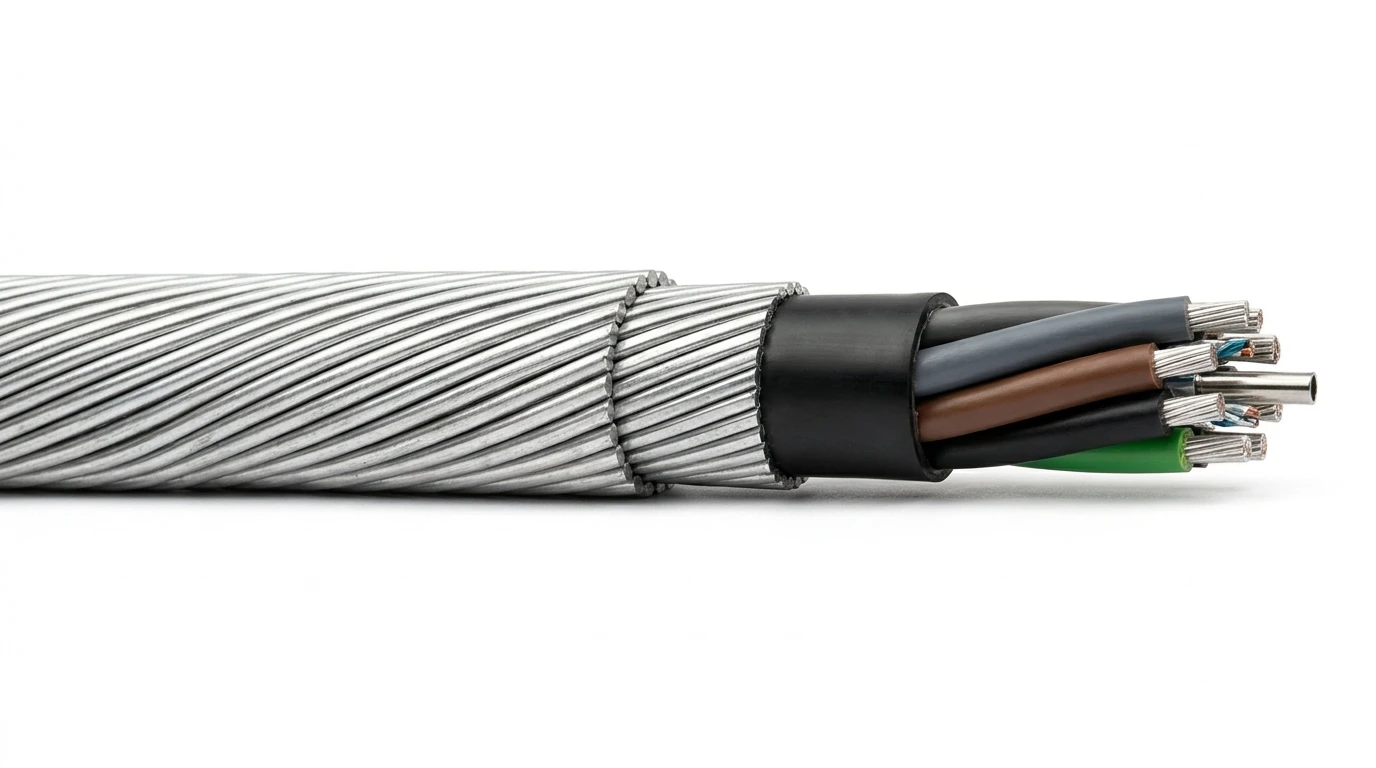
Whenever a subsea cable suspends equipment directly from an A-frame or crane sheave without a separate wire hawser, contra-helical steel wire armour serves as both the mechanical hoist rope and the radial crush shield on the traction winch:
- Two- or three-layer contra-helical SWA (exposed or HDPE-jacketed): The industry workhorse for 1–4.5 kV work-class ROV main-lift umbilicals (185 kN to 880 kN MBL), pontoon winch umbilicals (340 kN to 670 kN MBL) and 0.680 / 0.681 inch oceanographic deep-tow cables (177.9 to 204.6 kN MBL). Opposing inner and outer lay angles balance torque so the TMS does not spin as depth and wave heave vary.
- Four-layer and heavy crawler contra-helical SWA: Specified on seabed rock drills, CPT penetrometers, vibrocorers and deep-sea mining umbilicals (such as 45.6 mm SBD-SWA 4L-A304493 at 161 kN working / 645 kN MBL, or 65.4 mm A304613 at 253 kN working / 1,014 kN MBL) where shock breakout loads, extreme radial crush pressure and rock-ledge abrasion coincide.
If you are replacing an existing armoured cable on a grooved Lebus drum, always lock the finished diameter before freezing the armour wire gauges—see our companion winch groove and sheave diameter matching guide.
Why does the TMS-to-ROV excursion tether switch from steel armour to synthetic fiber and syntactic foam?
Once the TMS cage parks just above the subsea template or pipeline trench, the ROV swims horizontally 100 m to 500 m away. If that excursion cable were steel-armoured at 2 to 4.4 kg/m in water, the vehicle’s vertical thrusters would burn continuous power lifting dead cable weight and dragging steel wire across subsea structures.
Replacing steel wire with high-modulus aramid or LCP yarn braid delivers high tensile strength at one-fifth the specific gravity, while a foamed polymer flotation jacket tunes submerged weight close to zero in seawater (~1,025 kg/m³). Compare our heavy work-class ROV main tethers and trencher umbilicals, floating fiber-optic ROV tethers, neutrally buoyant multi-pair observation ROV tethers, and electro-hydraulic hybrid umbilicals depending on vehicle class.
How does the companion topside deck cable pair 1:1 with the wet umbilical?
On vessel bills of materials, buyers frequently see paired items such as RS726 FMV-RP2.6/2.4 (41.0 mm steel-wire-armoured wet umbilical) alongside RS726-DC FMBP (35.0 mm topside deck cable). As documented in our 300 m Southeast Asia 41.0 mm pontoon umbilical project record, both cables enclose the exact same 31.0 mm inner core assembly—Gs(12) + 9×16 mm² + 5×4 mm² + A2-0.35 mm²—so every phase conductor, auxiliary circuit, screened quad and single-mode fibre terminates pin-for-pin across the winch slip-ring junction box.
Replacing heavy contra-helical lift wire armour on the fixed topside run with dual 0.2 mm galvanized steel tapes and a 1.5 mm black flame-retardant PVC outer sheath (or an unarmoured HFFR elastomer jacket on custom spreads) cuts unit weight from 5,800 kg/km down to 2,800 kg/km, tightens minimum bending radius from 600 mm to 350 mm inside congested deck cableways, and eliminates greased bare wire across topside walkways.
Why do subsea spreads step up to 3.0–4.5 kV AC across long umbilical lengths?
Three-phase line current I = P ÷ (√3 × V × cos φ) · Resistive power loss P_loss = 3 × I² × R_conductor
Delivering 150 kW of hydraulic thruster and tooling power over a 3,000 m umbilical illustrates why medium-voltage insulation is mandatory on deepwater LARS spreads:
| Operating voltage | Phase current | Copper core size | 3,000 m voltage drop (approx.) | Practicality inside winch OD |
|---|---|---|---|---|
| 440 V AC | ~224 A | 95 mm² (0.193 Ω/km) | > 220 V (> 50% drop — unusable) | Exceeds practical winch OD and weight limits |
| 1,000 V AC | ~98 A | 25 mm² (0.78 Ω/km) | ~397 V (~40% drop over 3 km) | Suitable up to ~600–1,000 m inspection/light work spreads |
| 3,300 V AC | ~30 A | 16 mm² (≤ 1.27 Ω/km) | ~198 V (~6.0% drop over 3 km) | Fits cleanly inside 34–41 mm grooved winch umbilicals |
| 4,160–4,500 V AC | ~22–24 A | 8–16 mm² | ~3.5%–5.5% drop over 3 km | Standard deepwater 3,000–6,000 m work-class ROV envelope |
What to specify when ordering one segment or a matched three-cable package
Whether you are ordering a single spare tether, a replacement main-lift reel or a complete deck-plus-umbilical-plus-tether spread, include these six inputs in your technical inquiry:
- Segment role: Topside deck jumper, steel-armoured winch main-lift umbilical, TMS excursion tether, or towed array/corer cable.
- Winch & sheave envelope: Target nominal outer diameter and +/- mm groove tolerance, barrel/sheave diameter, and maximum number of wound layers.
- Tensile & depth duty: Required Safe Working Load (SWL), Minimum Breaking Load (MBL), maximum water depth and target in-water weight (heavy vs neutral vs floating).
- Power circuits: Core count × mm² (or AWG), rated AC/DC working voltage, frequency (50/60/400 Hz) and required factory HV test voltage.
- Optical & signal elements: Fibre count and type (ITU-T G.652.D SM, G.657.A1 bend-insensitive, or OM3/OM4 MM), FIMT vs tight-buffered design, plus screened pair/quad/coax impedances.
- Piece length & drum constraints: Continuous splice-free length per reel and any crane/deck footprint limits on export flange diameter or gross reel weight.
TEBAOFLEX engineers and manufactures all three subsea cable segments from a 50 m minimum order length, with factory lead times of 7 to 45 working days depending on stainless FIMT, synthetic/steel armour and length schedule. Browse our full marine and offshore cable range or submit your umbilical or tether specification for an engineering quote.
Questions
What is the main difference between an ROV main-lift umbilical and an ROV excursion tether?
A main-lift umbilical uses contra-helical galvanized steel wire armour (heavy in water, roughly 800–5,200 kg/km) to lower and recover the heavy TMS cage and ROV through the splash zone. An excursion tether uses synthetic aramid or LCP fibre strength members and foamed polymer buoyancy so it floats neutrally in water while the vehicle swims horizontally out of the TMS.
When does a subsea spread need four-layer steel wire armour instead of two-layer armour?
Two contra-helical steel armour layers handle standard work-class ROV LARS, pontoon winches and hydrographic deep-tow systems up to 670–880 kN breaking load. Four-layer and heavy multi-layer contra-helical steel wire armour (such as 45.6 mm 4L-A304493 at 645 kN MBL or 65.4 mm A304613 at 1,014 kN MBL) is selected for seabed rotary rock drills, CPT frames, vibrocorers and tracked deep-sea mining crawlers where extreme breakout pull, high radial crush pressure and near-zero rotation coincide.
Why do work-class ROV umbilicals operate at 3.0 kV to 4.5 kV AC instead of 400 V or 690 V?
Stepping hydraulic motor supply up to 3,000–4,500 V AC cuts phase current by four to seven times for the same shaft power (100–250 kW), allowing 4 mm² to 16 mm² copper conductors to keep voltage drop within 5%–10% across 1,500 m to 6,000 m umbilical lengths while keeping overall diameter compact.
Why does the topside deck cable omit contra-helical lift wire armour when it carries the same cores as the wet umbilical?
Between the containerized HV power van and the winch slip-ring junction box, the cable lies statically in deck trays with zero overboard suspension load. Replacing heavy contra-helical lift wire armour with light galvanized steel-tape + flame-retardant PVC (FMBP, as on 35.0 mm RS726-DC) or an unarmoured HFFR elastomer sheath cuts unit weight by more than 50% (5,800 down to 2,800 kg/km) and tightens static bend radius from 600 mm to 350 mm.
Can a free-swimming observation ROV use one tether all the way from the surface winch?
Yes, shallow and medium-depth observation ROVs operating without a TMS cage commonly run a single synthetic-fibre-reinforced neutrally buoyant or slightly buoyant tether directly from a surface hand reel or light winch, typically at 250–2,400 V DC or AC over 150 m to 1,000 m.
What minimum order quantity and lead time apply to custom ROV umbilicals, tethers and deck cables?
TEBAOFLEX manufactures steel-armoured main-lift umbilicals, synthetic-reinforced ROV tethers and matched FMBP or HFFR topside deck cables from a 50 m minimum order length, with production lead times from 7 to 45 working days depending on construction complexity.
Where coastal dredging pontoons, floating slurry pipelines and barge winches require flexible polyether-PUR or SHF2 power-optical umbilicals rated from 0.6/1 kV up to 6.6 kV rather than deep-water main-lift steel armour, see our DFP-EO and DFP-EOB dredger and floating pontoon umbilical schedule.
Matching tether buoyancy, voltage and diameter to vehicle thruster class is critical for ship-husbandry and inspection fleets: compare our TF-HULL 3–75 kW buoyant hybrid tether cable for ship hull biofouling cleaning robots (8GAX50, 12GAX49, 24XM308 & 13XM469 series), TF-RT work-class ROV TMS dynamic excursion tether (RT0084–RT0173 & 45XM301, 25–150 kN), TF-POT slim 400–800 V DC Power-over-Tether and FM022702 aramid multi-element ROV tether, DLRB-3TP6C & GAX250 (2GAX160–8GAX163) 26 AWG neutrally buoyant micro-ROV tether, 4GAX181 & 2,400 V floating fiber-optic ROV tether, and TF-NBCAT5E foil-shielded 24 AWG Cat5e FTP & Cat6 neutrally buoyant ROV Ethernet cable.
For portable 4.0–9.8 mm underwater cleaning drones, dam-penstock UUVs and offshore wind foundation crawlers, also review our TF-DRONE (1GAX119 coax, 2GAX113 anti-kink fiber, 2GAX123 250m & 600V 5-pair) underwater drone micro-tether, TF-OWIND 690 V–3.3 kV offshore wind monopile cleaning & PAUT/ACFM NDT crawler umbilical, and our calculation guides on ROV tether buoyancy, current drag & depth foam compression and polyether PUR vs LDPE tether potting & compression penetrator tolerances.