







TEBAOFLEX Open-Pit & Underground Mining Trailing Cable Materials Guide
Mine electrical superintendents specifying North American Type SHD-GC (2–25 kV), Type G-GC (2000 V), Type PG & Type PCG, center-pilot Type SHD-CGC, illuminated SHD-GC LED, European (N)TMH3S / (N)TSCGEWÖU, or African SANS 1520 cables face a critical outer-sheath decision: stick with traditional cross-linked Chlorinated Polyethylene (CPE) / Polychloroprene (PCP / CSP) rubber, or upgrade to Extra-Heavy-Duty Ether-Based Thermoplastic Polyurethane (TPU)? Selecting the wrong polymer either triples splice downtime on sharp quartzite muck piles or risks thermoplastic softening on overheated multi-layer cable reels. Use the quantitative engineering boundaries below to match jacket chemistry to your mine floor.
Quantitative Comparison: Ether-TPU vs. Thermoset CPE vs. Vulcanized PCP / CSP
Under ICEA S-75-381 / NEMA WC 58, CAN/CSA C22.2 No. 96, DIN VDE 0250 (5GM5 / 11Yh) and SANS 1520, outer jackets are tested for tensile strength, tear propagation, oil immersion and flame retardance—yet real-world open-pit and hard-rock drift survival hinges on cut-growth and abrasion volume loss:
| Property / Duty Factor | Extra-Heavy-Duty Ether TPU (11Yh) | Thermoset CPE (Mold-Cured / CV) | Vulcanized HD-PCP / CSP (5GM3/5GM5) |
|---|---|---|---|
| Polymer Cross-Link Nature | Thermoplastic elastomer (melts >165–180 °C) | Cross-linked thermoset (no melt at +250 °C SC) | Cross-linked thermoset rubber (no melt) |
| Typical Tensile Strength | 35–48 MPa (2.3×–3× rubber) | 14–18 MPa (ICEA EHD baseline) | 16–22 MPa (VDE 5GM5 / BS HOFR) |
| ISO 4649 Abrasion Loss | 35–50 mm³ (highest rock-drag life) | 115–155 mm³ | 90–125 mm³ |
| Graves Tear Strength | ≥50–80 kN/m (resists rib nick propagation) | 18–28 kN/m (requires reinforcing cord) | 22–35 kN/m (with anti-torsion mesh) |
| Cold-Bend / Impact Floor | −40 °C to −50 °C (stays supple on ice) | −35 °C to −40 °C (compound-dependent) | −25 °C to −35 °C |
| Halogen & Transparency | Halogen-free option; optical clarity for LED | Chlorinated (opaque colors only) | Chlorinated (opaque colors only) |
The Underground Hydrolysis Trap: Always Specify Polyether (Ether-Based) TPU
Not all polyurethane jackets survive underground mines. Generic industrial PUR cables often use polyester-based TPU for oil stiffness—a fatal mistake in damp headings, shaft sumps and tropical open pits:
- Polyester TPU Failure Mode: Standing mine water (especially acidic pH 3.0–5.5 sulfide drainage in copper, gold and coal seams) attacks ester linkages via hydrolysis, turning the jacket sticky, chalky and split within 6–12 months.
- Polyether (Ether-Based) Mining TPU Solution: TEBAOFLEX formulates all mining polyurethane sheaths—across SHD-GC LED (2–25 kV), (N)TMH3S 0.6/1 kV TPU Reeling Cable, XLPE/PUR Halogen-Free Jumbo Reeling Cable, and optional TPU builds on Type PG / PCG, Type G and SANS 1520—exclusively with hydrolysis-stabilized polyether TPU plus UV absorbers.
- Drum Weight & Diameter Reduction: Because ether-TPU achieves ≥35 MPa tensile strength at ~1.18 g/cm³ density (vs ~1.38 g/cm³ for chlorinated CPE), an 8 kV 3×4/0 AWG trailing cable sheds roughly 7%–12% net mass, cutting hydraulic reel motor torque on drill jumbos and electric shovels.
Where Cross-Linked CPE & Neoprene (PCP) Still Outperform TPU
Why haven’t mines replaced 100% of thermoset CPE and polychloroprene cables with TPU? Because TPU is thermoplastic, whereas vulcanized CPE and PCP are permanently cross-linked thermosets:
- Tightly Spooled Multi-Layer Shuttle-Car Reels: When 4 to 6 layers of flat cable remain wound on a compact low-seam drum at peak current, inner-layer heat buildup can push sheath temperatures past +105–120 °C during stalls. Cross-linked CPE and mold-cured neoprene on Type SHD Flat 3/C 2000 V and Flat Type G 2/C 2000 V refuse to deform or fuse between wraps under +130 °C emergency overload and +250 °C short-circuit spikes.
- Vulcanized Hot Field Splicing: Underground coal maintenance crews equipped with traditional vulcanizing press molds for thermoset CPE/neoprene (Type SHD-CGC 5 kV, SHD-GC) must use polyurethane-compatible cold-cast resin or TPU heat-sleeve kits when splicing TPU jackets.
- Concentrated Acid / Solvent Splash: In fixed mineral-processing acid-leach and kerosene solvent-extraction bays, chlorinated thermoset CPE over welded metallic armor (Type MC-HL) provides unmatched chemical barrier stability.
Anti-Runover Visibility Tiers: Solid Hi-Vis TPU vs. Dual-Layer Wear-Indicator vs. SHD-GC LED
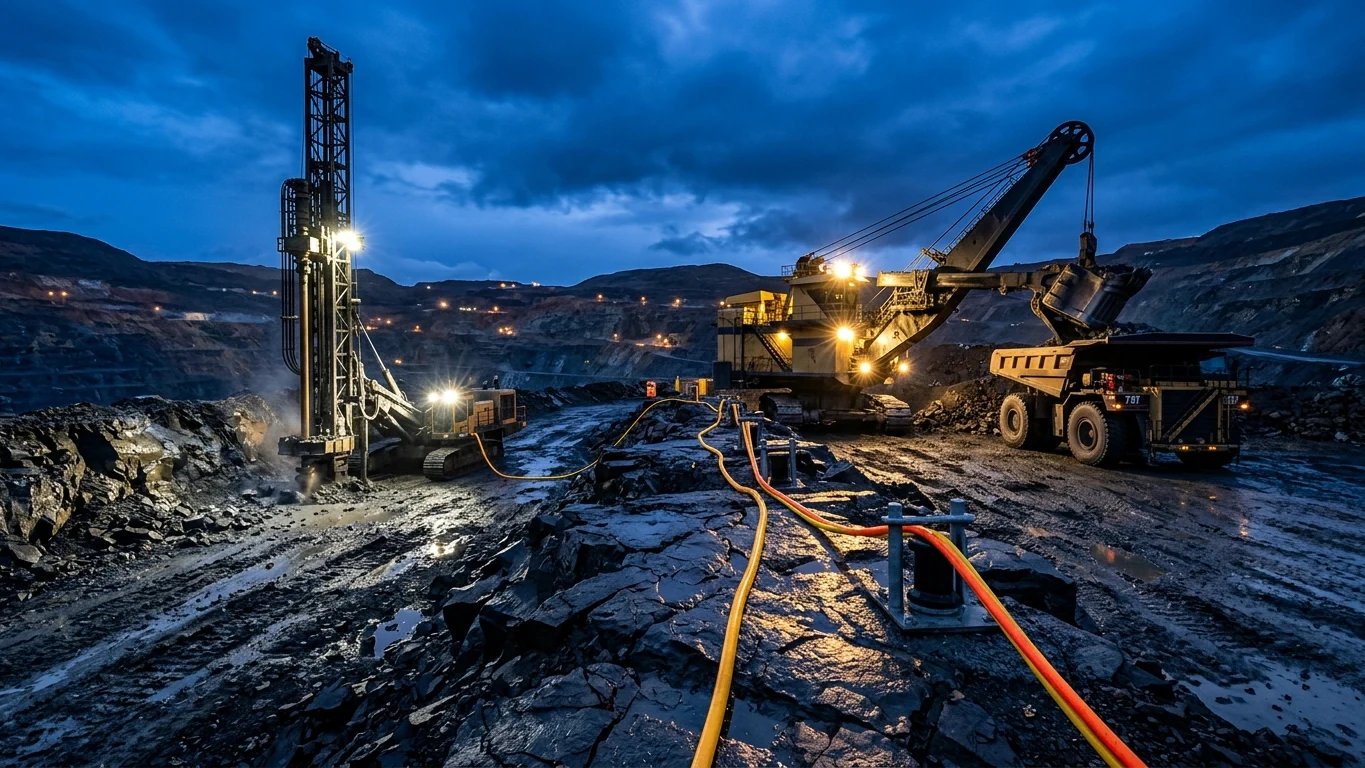
Run-over crushing by rubber-tired LHDs, graders and haul trucks causes more medium-voltage trailing failures than electrical aging (see our Mining Trailing Cable Damage Prevention Guide). Matching jacket visibility to traffic density prevents costly splices:
- Tier 1 — Solid Safety-Yellow / Orange CPE or EHD TPU: High daylight and headlight contrast against dark basalt, coal and wet muck on open-pit benches (SANS 1520-1 / -2, (N)TMH3S).
- Tier 2 — Dual-Layer Color-Contrast Wear-Indicator Extrusion: Co-extruding a bright yellow or orange outer sheath over a contrasting black or red inner bedding gives maintenance inspectors an immediate visual wear gauge—retire or rotate the cable the moment inner color peeks through rock gouges.
- Tier 3 — Active Helical LED Illumination in Transparent TPU (SHD-GC LED 2 kV–25 kV): Embedding a continuous helical LED strip beneath optical-clarity UV-stabilized EHD TPU (covering ICEA S-75-381 2–25 kV and CSA C22.2 No. 96 −40 °C schedules, bulk MOQ 300 m) turns the entire energized cable into a glowing safety line in pitch-dark underground intersections, fog and arctic winter shifts. For passive zero-power afterglow under DIN VDE rules, compare (N)TSCGEH3S Luminescent Trailing Cable.
Boundary Check: Mobile Trailing Jackets vs. Fixed Mine Plant Type MC & MC-HL Armor
Flexible rubber and TPU trailing cables are engineered for mobile machinery—never waste expensive rope-lay trailing cable in fixed concentrator cable trays where metallic armor cuts cost and satisfies NEC / NOM-001-SEDE plant codes:
- 5 kV–35 kV Grinding Mill, Crusher & Substation Ladder Trays: Specify Type MC MV-105 Interlocked Armored Feeder Cable (AIA / GSIA, 4 AWG–1000 kcmil, MOQ 300 m) or underground pilot-monitored Type MP-GC / vertical shaft Type MPF-GC.
- 600 V & 2 kV SX-EW Tankhouse & Slurry-Pump VFD Drives: Specify gas/vapor-tight Type MC-HL Continuous Corrugated Welded Aluminum VFD Cable (3 Symmetrical Grounds, MOQ 300 m).
Frequently Asked Questions: TPU vs. CPE Mining Cable Jackets
When does Extra-Heavy-Duty TPU outperform thermoset CPE on SHD-GC and Type G-GC mining cables?
3x to 4x lower abrasion volume loss (<=35–50 mm³ vs 120–160 mm³ per ISO 4649), >50 kN/m tear strength, and -40 °C cold-impact resilience make ether-based TPU superior on sharp basalt/quartzite haul benches, underground drill jumbo reels, and arctic pits; however, thermoset CPE remains superior above +90 °C hot-slag splash zones because TPU is thermoplastic.
Why must mining trailing cables specify ether-based TPU rather than ester-based TPU?
Water and microbial hydrolysis is the reason: ester-based polyurethanes split chemically and crumble within months in warm, wet underground sumps and acidic pH 3–5 mine water, whereas polyether-based (ether-grade) TPU resists continuous water immersion, mud microbes, and sub-zero flexing.
How does a TPU jacket reduce reeling drum weight compared with CPE on 8 kV and 15 kV SHD-GC cables?
7% to 12% lower linear cable mass is typical because TPU's higher tensile strength (>=35 MPa vs ~14–17 MPa for CPE) and lower specific gravity (~1.18 vs ~1.38 g/cm³) allow a slimmer outer diameter without sacrificing cut-through resistance.
What is the difference between active SHD-GC LED transparent TPU and dual-layer color-contrast TPU?
Active SHD-GC LED embeds a helical LED warning strip beneath optical-clarity UV-stabilized transparent TPU so energized lines glow in darkness (MOQ 300 m), whereas dual-layer wear-indicating TPU co-extrudes a contrasting inner layer (e.g., red or black) beneath a solid yellow/orange outer TPU layer to reveal sheath wear visually before screens are exposed.
What are TEBAOFLEX's minimum order quantities and lead times for CPE, rubber and TPU mining cables?
50 m is our standard minimum order quantity for CPE and vulcanized rubber portable mining cables, while specialized continuous-extrusion lines such as illuminated SHD-GC LED transparent TPU and Type MC / MC-HL armored mine plant cables carry a 300 m MOQ, all delivered in 7 to 45 working days.
Browse all North American, European, British, Australian and African mining specifications in our Mining & Tunneling Cables Catalog, cross-check regional codes in the Mining Cable Designation Cross-Reference, or send your voltage, AWG/mm² schedule and mine environment for an engineering quote →