

Open-pit, underground and tunnel equipment
Mining Cable Solutions for Mobile Equipment and Tunneling
Match cable construction to the machine and movement pattern before comparing model names. This solution maps open-pit, underground and TBM systems to reeling, trailing, fixed distribution, pump and monitored medium-voltage cable routes.
- TBM and tunnel routes
- LHD, shovel and dragline
- Reeling, trailing and fixed distribution
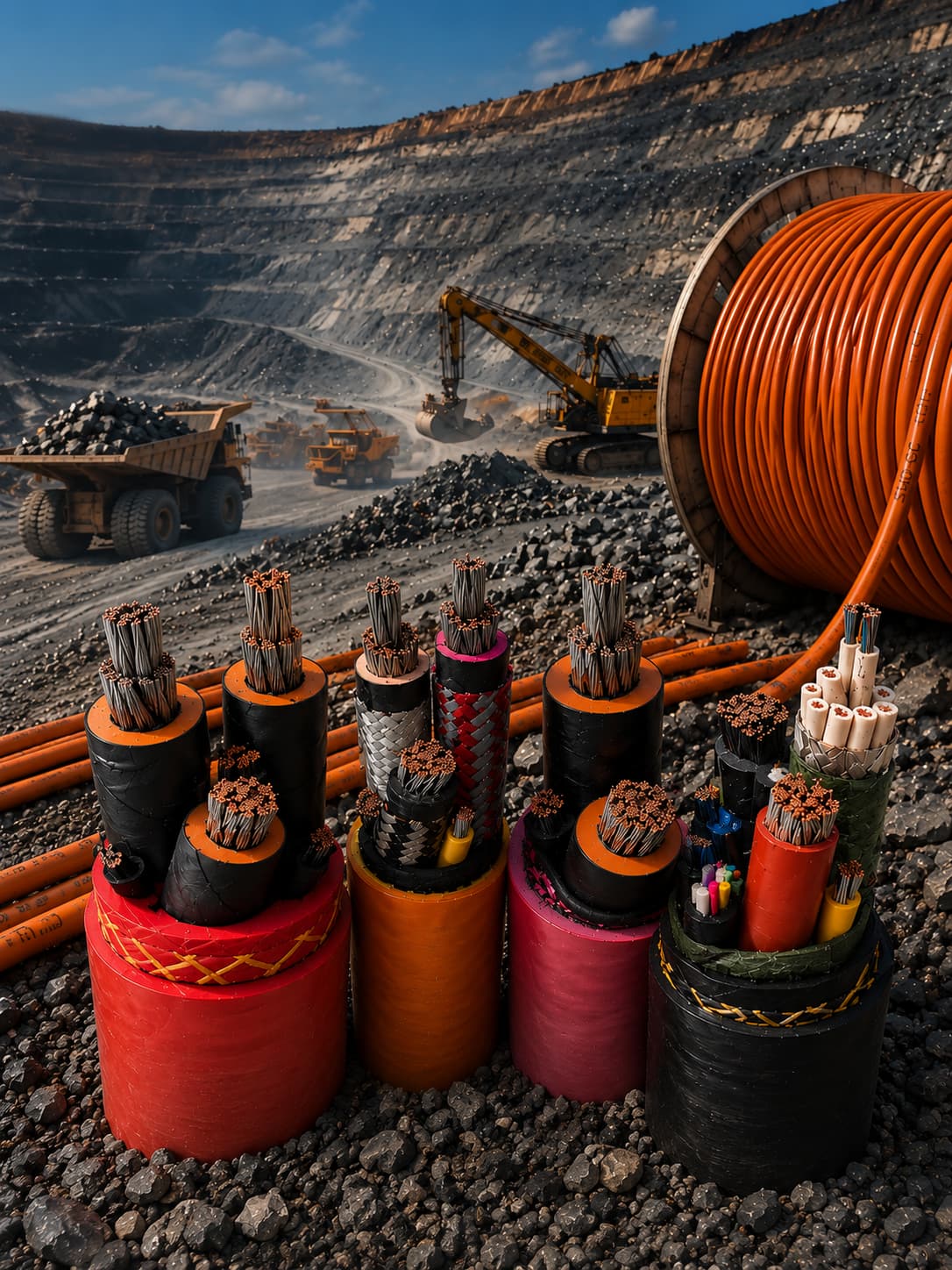
Choose by system duty, not by name alone
Use this page to narrow the cable route before comparing a product model or submitting a specification.
Start with the equipment
Identify the machine, circuit function, route and the consequence of cable failure at that location.
Define the complete duty
State voltage or transmission needs together with movement, bending, load, fluids, temperature and installation exposure.
Confirm one construction
Review conductor or fibre elements, screens, reinforcement, sheath, termination, standards and documentation as one schedule.
Match the cable to the equipment and route
A mine contains several different cable duties. The route may be reeled every shift, dragged behind a machine, suspended, submerged at a pump or installed as a flexible feeder that only moves during relocation.
Tunnel boring machines
Medium-voltage power, reeling and onboard flexible routes exposed to drum cycles, water, abrasion and restricted bend geometry.
Underground LHD and loaders
Reeling or trailing supply cables where torsion, vehicle traffic, sheath damage and compact routing drive construction.
Shovels and draglines
Long medium-voltage reeling or trailing routes requiring tensile control, monitoring conductors and heavy mechanical protection.
Open-pit mobile equipment
Portable power for drills, excavators, stackers and mobile substations exposed to sun, dust, oil and repeated relocation.
Pumps and dewatering
Wet-duty power routes where immersion conditions, entry seals, voltage drop, depth and fluid chemistry must be defined.
Conveyors and distribution
Fixed or semi-mobile mine distribution routes with clear separation from dynamic reeling and trailing duties.
Define the conditions that control cable life
Electrical rating alone does not establish cable life. Mobile mine cable selection must combine the power system, protection scheme, movement, route geometry and the physical damage mechanisms on site.
State how often the cable moves, whether it winds under tension and whether torsion or reverse bending is present.
Confirm rated voltage, screen, ground-check or pilot cores, coupler arrangement and mine protection requirements.
Define abrasion, crushing, impact, tensile load, drum pressure, vehicle traffic and minimum bending radius.
Separate occasional wet exposure from immersion and identify mine water, oils, chemicals, cold or elevated temperature.
Compare suitable cable-family routes
Use the machine duty to narrow the family. Product model, voltage and conductor size come after the movement mode, monitoring requirement and route risk are clear.
TBM reeling cables
Screened medium-voltage cable for tunnel boring machine drums and moving backup systems, selected by drum, tension and monitoring data.
View TBM cableLHD and loader reeling cables
Flexible rubber cable for compact mobile equipment where repeated winding, torsion and sheath abrasion are central risks.
View LHD reeling cableMedium-voltage reeling cables
Power routes for shovels, draglines and mobile plant with screens, pilot or ground-check conductors and reinforcement as specified.
View MV reeling cableTrailing and portable mine cables
Flexible cables laid or dragged along equipment routes where abrasion, impact and frequent handling are expected.
View portable trailing cableNorth American mining cables
SHD-GC, Type G-GC and Type W routes selected by voltage, shielding, ground-check arrangement and equipment duty.
View SHD-GC cableFixed tunnel distribution
Medium-voltage feeders and semi-mobile distribution routes that must be separated from the dynamic cable installed on the TBM.
View tunnel feeder cableTurn the application into a cable selection route
Use the matrix to identify the next technical route. Final construction follows the complete project schedule and operating inputs.
| Equipment or Route | Cable System | Inputs to Confirm | Selection Route |
|---|---|---|---|
| TBM main power reel | Screened MV TBM reeling cable | Voltage, reel type, layers, drum diameter, speed, tension, route length and pilot/FO cores | (N)TSCGECWOU family |
| LHD or scoop loader | Compact rubber reeling cable | 0.6/1kV or MV, torsion, reverse bending, drum and mechanical damage | NSHTOEU family |
| Shovel or dragline | Heavy-duty MV reeling/trailing cable | Screen, ground-check, tensile load, coupler, bend radius and relocation pattern | R-(N)TSCGEWOU or SHD-GC |
| Portable mining machine | Trailing or Type 209 cable | Voltage, earth/pilot cores, movement frequency, oil, water and abrasion | NTSWOU-J or Type 209 |
| Mine pump | Wet-duty pump or mining rubber cable | Depth, immersion, fluid, entry seal, current, length and voltage drop | Submersible or mining family |
| Tunnel distribution | Fixed or semi-mobile MV feeder | Installation method, fire requirement, screen, joints, route and project standard | 2XSEYQY route |
| North American mobile equipment | SHD-GC, Type G-GC or Type W | Voltage, shield, ground-check, core layout, jacket and mine document requirements | Compare by protection scheme |
Engineering and test references
References are selected for the confirmed construction and project duty. The quotation and inspection plan define the applicable methods, conditions and acceptance values.
Reference 1
DIN VDE 0250 and HD 620 construction references where the tender names European mining or reeling cable families.
Reference 2
ICEA, NEMA, MSHA-related or client specifications checked for SHD-GC, Type G-GC and Type W enquiries.
Reference 3
IEC flame, material and electrical test references applied only when named for the exact project and cable.
Reference 4
Mine approval, coupler, marking and document requirements confirmed before any model is proposed as equivalent.
From operating data to an agreed cable schedule
The process keeps equipment, cable construction, interfaces and documentation aligned before production.
Share the operating duty
Provide the equipment, electrical or transmission services, movement, route and environment.
Review the cable route
Separate circuit functions and compare the constructions that fit the operating duty.
Confirm the technical schedule
Agree the construction, dimensions, interfaces, standards, inspection stages and document list.
Manufacture and inspect
Production, marking, packing and agreed inspection follow the confirmed order specification.
Frequently asked questions
Short answers to common questions before a project-specific cable review.
What is the difference between reeling and trailing mining cable?
A reeling cable is selected around winding on a drum, including layers, drum diameter, tension, speed and reverse bending. A trailing cable is laid, moved or dragged with equipment and is selected around handling, abrasion, impact and route conditions.
Why are pilot or ground-check conductors important?
They support the monitoring and protection arrangement specified for the mining system. The exact conductor layout, coupler and protection scheme must be confirmed with the equipment and mine electrical requirements.
Does a TBM use one cable type for the complete route?
Usually the route should be divided into fixed tunnel distribution, the moving backup or reeling section, onboard flexible connections and auxiliary services. Each section has different movement, protection and installation constraints.
What information is needed for a mining cable quotation?
Provide the machine, movement mode, voltage and system arrangement, conductor size, screen and monitoring cores, route and cable length, reel data, bend radius, tensile load, water, oil and abrasion exposure, quantity and required documents.
Additional mining cable models for project shortlisting
The following product pages support the selection matrix above. Use them as model-level references, then confirm the equipment, voltage, route geometry, grounding or pilot arrangement and document scope with the RFQ.
- P1209 Accessor Trunk Cable for underground monitoring and low-voltage power/data trunk systems.
- TRMC-J Mining Cable and TYPE275 1.1 kV Flexible Shuttle Car Mining Cable for severe mobile and trailing duties.
- Type 210 Flexible Rubber Mining Cable and Type 41 Cable 640/1100V for portable equipment routes.
- Type 240 Underground Coal Mine Cable and Type 241 Mining Cable for screened coal-mine power families.
- TYPE260 Armoured Screened Mining Power Cable and Type412 Armoured Mining Power Cable where mechanical protection and mining power supply are part of the specification.
- (N)SSHCGEWÖU Mine Lighting Cable for monitored 0.6/1 kV lighting and tunnel circuits.
- Type 622 Mining Cable and Type 63 Mining Cable 1.9/3.3kV for medium-voltage reeling or trailing review.
- Type MP-GC 15kV Mine Power Feeder Cable and NTMCWOEU Cable for fixed feeder or flexible switchgear-connection review.
Send the inputs needed for a useful cable review
Include the information available now. Drawings, old cable markings, cross-section photos and project specifications can be attached through the enquiry form.
- Machine: TBM, LHD, shovel, dragline, drill, pump, conveyor or mobile substation
- Movement: reeling, trailing, fixed, suspended, submerged or occasional relocation
- Rated voltage, system voltage, conductor size, current and route length
- Screen, earth, ground-check, pilot, control or fibre optic core requirement
- Reel type, drum diameter, layers, speed, acceleration, tensile load and bend radius
- Water, oil, abrasion, crushing, impact, UV, flame and temperature exposure
- Coupler, gland, termination, marking and mine approval requirement
- Standard, document list, cable length, quantity, drum and delivery country