


Cable insulation materials
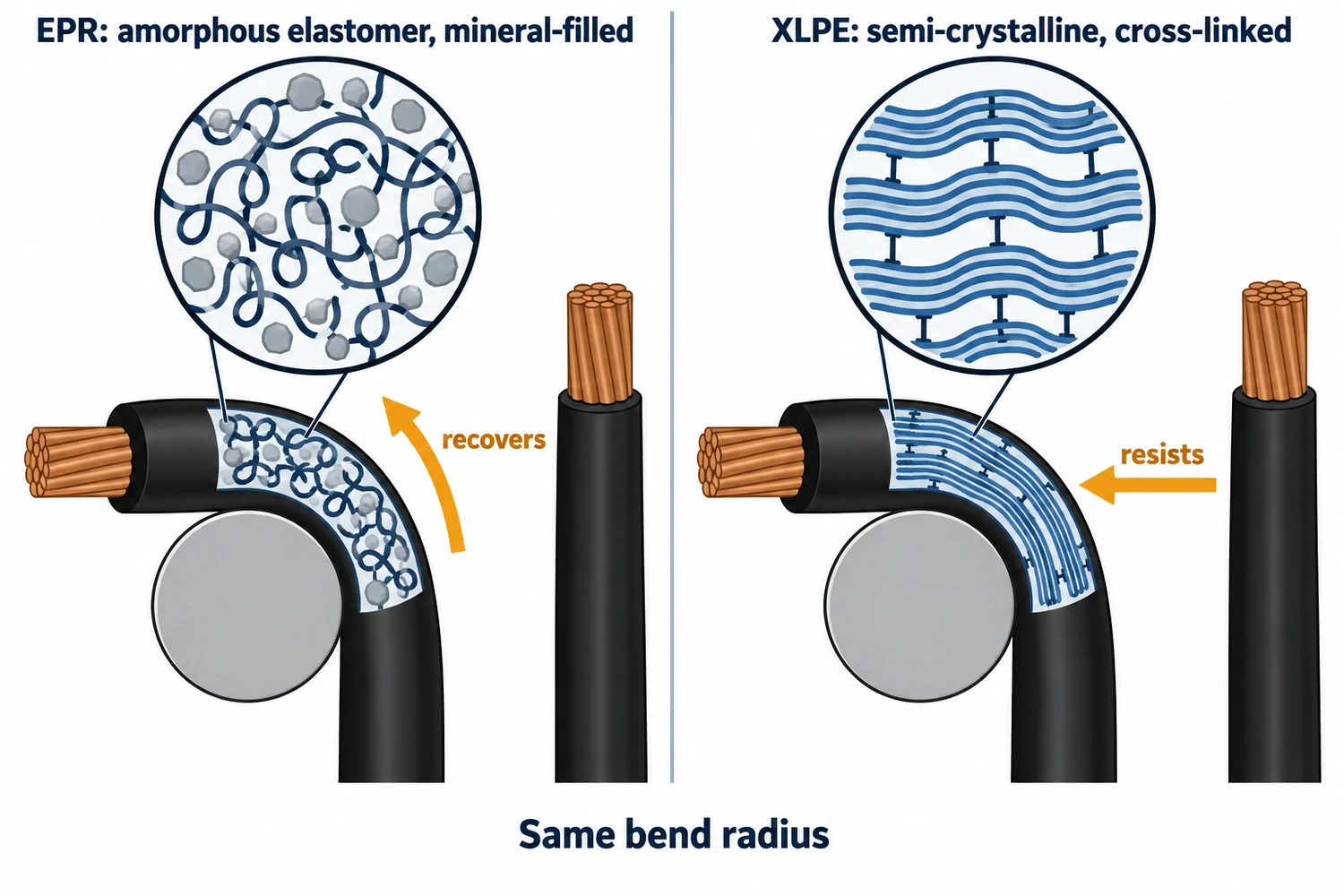
EPR insulation is a cross-linked ethylene propylene rubber compound extruded over a conductor as the cable’s dielectric. It is an amorphous rubber rather than a semi-crystalline plastic, which is why trailing, reeling, locomotive and portable cables are typically EPR-insulated while fixed medium-voltage feeders lean towards XLPE. Both carry the same 90 °C conductor rating under IEC 60502-1; the difference is what happens when the cable has to bend, get wet and keep working.
EPR insulation at a glance
Ask a utility engineer and an underground-mine electrician which insulation they want, and you get two confident, opposite answers. Neither is wrong. The utility engineer is thinking about a 15 kV feeder that will lie in a duct for forty years. The mine electrician is thinking about a shovel cable that gets dragged through slurry, coiled on a reel and flexed a few hundred thousand times before it is retired. Those two jobs reward different polymers, and the table below is the short version of why.
| Question | EPR | XLPE |
|---|---|---|
| Conductor rating (IEC 60502-1:2021, Table 3) | 90 °C normal, 250 °C short circuit | 90 °C normal, 250 °C short circuit |
| Polymer structure | Amorphous elastomer, mineral-filled | Semi-crystalline polyethylene, cross-linked |
| Repeated flexing, small bend radius | Its purpose | Tolerated in installation, not as a duty |
| Wet service and water treeing | Low sensitivity | Needs a tree-retardant grade (TR-XLPE) or barrier |
| Corona, partial discharge, tracking | High resistance | Lower resistance |
| Dielectric loss and breakdown strength | Higher loss, lower strength | Lowest loss, highest strength |
| Typical home | Mining, reeling, locomotive, portable and marine cables | Fixed distribution feeders, building wire, tunnel power cable |
If the cable moves, gets wet, or lives next to a motor drive, EPR is the default. If it is pulled once, buried or trayed, and asked to carry medium voltage cheaply for decades, XLPE is. Everything below is the reasoning, so you can defend the choice to whoever signs the purchase order.
What is EPR insulation?
EPR insulation is a cross-linked ethylene propylene rubber compound extruded over a cable conductor as its dielectric. Because the base polymer is an amorphous rubber rather than a semi-crystalline plastic, it stays flexible from about −40 °C up to a 90 °C conductor rating, and it resists moisture, ozone, sunlight and partial discharge better than polyethylene-based insulations.
The name covers a family, not one recipe. The base rubber is a copolymer of ethylene and propylene (EPM) or a terpolymer with a small amount of diene (EPDM), which is why the same material turns up on datasheets as EPR, EPDM or “EP rubber”. IEC 60502-1:2021 simply defines EPR as “ethylene propylene rubber or similar (EPM or EPDM)” and adds a hard grade, HEPR, for medium-voltage walls. The polymer’s glass transition sits around −60 °C, which is the physical reason it bends in a cold pit rather than cracking (polymer data via Wikipedia, citing IISRP).
What goes on the reel is not raw rubber. A cable EPR compound is the resin plus, typically, eight or more additives: inorganic mineral fillers, antioxidants, flame retardants for low-voltage grades, curing agents and stabilisers, mixed under clean-room discipline and then cross-linked after extrusion (Southwire application note 2004, 2017). The familiar red-salmon colour of medium-voltage EPR came from a red lead stabiliser; lead-free compounds are off-white. Colour, in other words, tells you about the stabiliser package, not the performance.
That filler content is the source of EPR’s split personality. Fillers give it tracking resistance, dimensional stability above 100 °C and a low sensitivity to water treeing. They also raise its dielectric loss and lower its breakdown strength compared with a clean, unfilled polyethylene. Every argument about EPR vs XLPE is really an argument about whether your cable needs the filled rubber’s toughness or the clean plastic’s electrical purity.
Why do flexible and portable cables use EPR instead of XLPE?
Flexible and portable cables use EPR because an amorphous elastomer flexes at a small radius and recovers without permanent set, while cross-linked polyethylene is stiffer and holds its shape. North American portable cable standards ICEA S-75-381 and UL 1650 are written around EPR-insulated Type W, G, G-GC and SHD-GC constructions rated 90 °C with −40 °C cold-bend performance.
A trailing cable on a continuous miner has a harder life than most of the people specifying it. It is dragged, run over, coiled, uncoiled, soaked and then asked to carry a few hundred amps at 2 kV without complaint. The conductor is rope-lay fine-stranded copper precisely so that it can bend; an insulation that cracks on the third cold morning wastes that copper. This is the job ANSI/NEMA WC 58 / ICEA S-75-381-2017 exists for: its scope covers “portable cables for use in mining machines, dredges, shovels and similar equipment”. Manufacturer datasheets built to it list “ethylene-propylene rubber (EPR) per ICEA S-75-381” and a working range of −40 °C to +90 °C (Priority Wire Type G-GC datasheet, 2026; Southwire Type W via IEWC, 2010). The same pattern runs through TEBAOFLEX’s own range: the Type W 600–2000 V portable power cable, the Type G-GC 2000 V ground-check cable and the SHD-GC 2–25 kV shielded mining cable are all built on 90 °C EPR under a reinforced CPE jacket.
Europe reaches the same conclusion by a different route. The standard flexible rubber cable, H07RN-F, is built to EN 50525-2-21 with an EI4 insulation compound under EN 50363, and EI4 is an ethylene propylene rubber (Eland Cables H07RN-F datasheet). German-designation reeling cables such as the (N)TSCGEWÖU medium-voltage crane reeling cable carry a screened 3GI3 EPR insulation system up to 12/20 kV for exactly the reason the mine cable does: the drum never stops turning.
There is a quieter electrical reason as well. EPR has higher dielectric loss at high frequency than XLPE, and on a cable feeding a motor from a variable-speed drive that loss is a feature: it damps the fast transients from drive switching and vacuum breakers that would otherwise arrive at the motor winding undiminished (EPR Cable Technology Consortium, University of Connecticut). Locomotive traction leads and mine-shovel motor cables live on exactly that kind of circuit, which is one more reason 2 kV DLO cable pairs a rope-lay tinned conductor with thermoset EPR, as explained in what DLO cable is and how it is built.
EPR vs XLPE: what actually differs?
EPR and XLPE share the same 90 °C normal and 250 °C short-circuit conductor limits in IEC 60502-1, so the thermal rating is not what separates them. XLPE has the lower dielectric loss and the higher breakdown strength; EPR has the lower modulus, the lower sensitivity to water treeing and the higher resistance to corona, tracking and ozone.
The numbers behind that summary come from a transmission-class comparison that is still the reference point thirty years on. Comparing a 138 kV XLPE cable with a 150 kV EPR cable, Chan, Hartley and Hiivala found the XLPE cable’s AC withstand and breakdown strength at least 25 % higher, its impulse strength about 70 % higher, and its loss factor at least 20 times lower (IEEE Electrical Insulation Magazine, vol. 9, 1993). At transmission voltage those differences decide the wall thickness and the losses over a hundred kilometres. On a 2 kV, 150 m shovel cable they are invisible, and the mechanical column takes over.
| Property | EPR | XLPE | Why it matters on site |
|---|---|---|---|
| Base polymer | Amorphous ethylene-propylene rubber, mineral-filled, cross-linked | Semi-crystalline polyethylene, cross-linked by peroxide, silane or radiation | EPR bends and recovers; XLPE resists bending and keeps its shape |
| Conductor temperature (IEC 60502-1:2021 Table 3) | 90 °C normal, 250 °C short circuit | 90 °C normal, 250 °C short circuit | Neither buys you ampacity over the other in an IEC design |
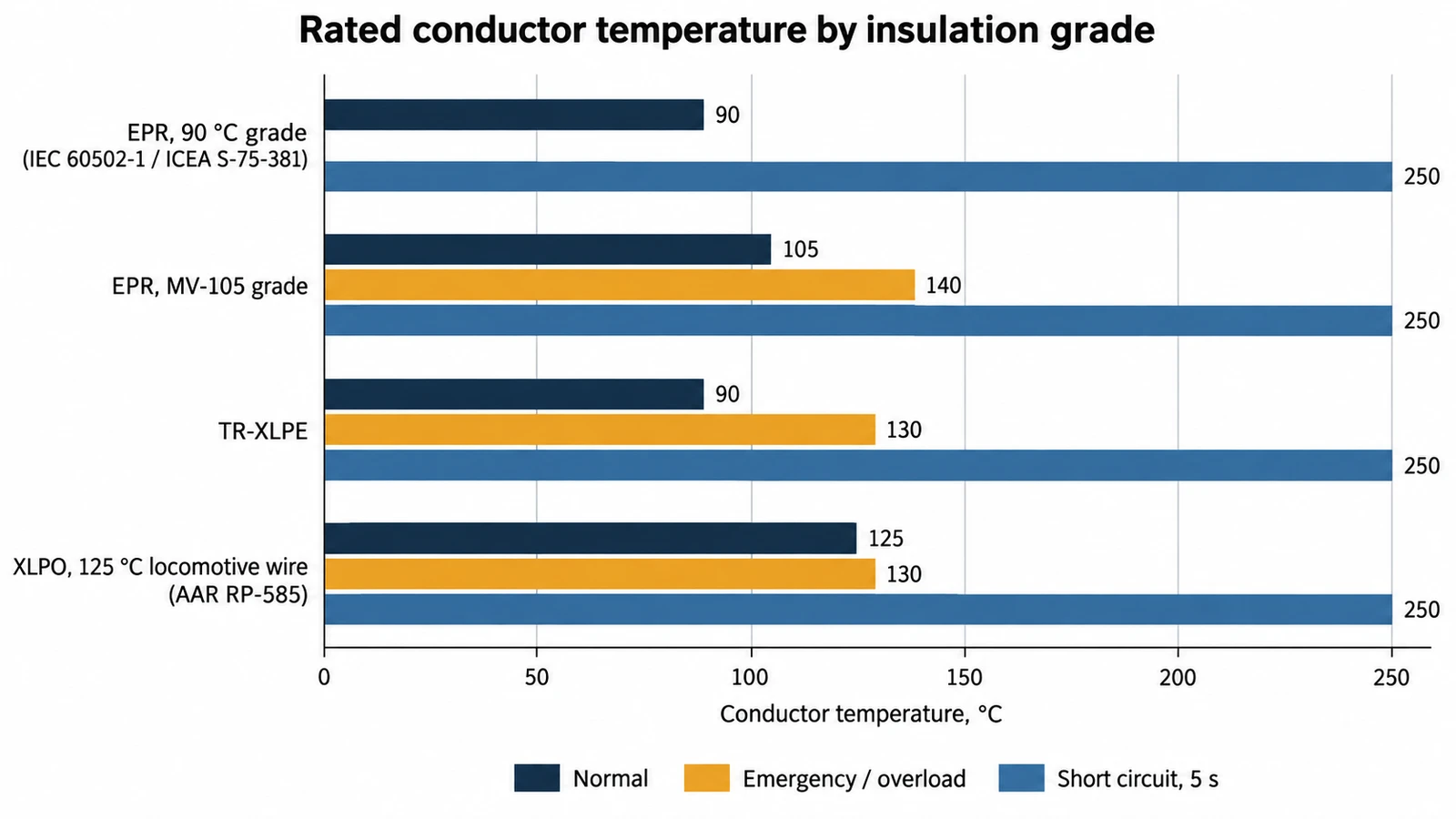
| US medium-voltage grades (ICEA S-93-639 / UL 1072 constructions) | MV-105 EPR: 105 °C normal, 140 °C emergency, 250 °C short circuit | TR-XLPE: 90 °C normal, 130 °C emergency, 250 °C short circuit | The 105 °C badge belongs to a medium-voltage EPR grade, not to every EPR cable (Border States via Tano Cable) |
| Dielectric loss | Higher; loss factor at least 20× XLPE at transmission class | Lowest of the solid dielectrics | Decides long HV runs; immaterial on short low-voltage machine cables |
| Breakdown and impulse strength | Lower (XLPE at least 25 % higher AC, about 70 % higher impulse) | Higher | XLPE walls can be thinner at high voltage |
| Water treeing | Low sensitivity: filled, hydrophobic compound | Susceptible unless tree-retardant grade or moisture barrier is used | Wet mines, pump cables, direct burial without a metallic sheath |
| Corona, partial discharge, tracking | High resistance | Lower resistance | Shielded medium-voltage trailing cable, terminations that see contamination |
| Ozone and sunlight | Inherently resistant | Needs a jacket for outdoor exposure | Festoon and reeling cables run outdoors for years |
| Oil | The rubber itself is not oil-resistant; the jacket does that job | Moderate | Both need a CPE, PCP or TPU jacket where oil is present |
| First cost | Reported higher in US utility practice | Reported lower | Sources conflict; treat cost as a quotation question, not a rule |
The corona and treeing rows are why EPR carried the medium-voltage industrial market for decades while XLPE carried the utility market. Filled EPR is hydrophobic and has a controlled wet conductivity, which is the first-principles reason it grows water trees far more slowly than unfilled polyethylene; it also has much greater tracking resistance than the older rubbers it replaced (UConn consortium, above). Manufacturer literature makes the same claims commercially: Okonite describes its EPR system as having “excellent corona resistance”, “exceptional resistance to treeing” and “exceptional resistance to moisture” on a 90 °C-rated IEC 60502-2 construction (Okonite product data sheet 2-47). Eland Cables adds the honest counterweight: EPR’s dielectric properties “are not as good as those of XLPE”, but it brings extra flexibility, reduced thermal expansion and low sensitivity to water treeing (Eland Cables FAQ).
| Duty | Specify | Choose this when |
|---|---|---|
| Trailing, reeling or festoon cable, 600 V to 25 kV | EPR under a reinforced thermoset jacket | The cable moves in service, is handled repeatedly, or is coiled on a drum: Type W, Type G-GC, SHD-GC, (N)TSCGEWÖU |
| Locomotive, generator and motor leads, 2 kV, 90 °C | EPR with an XL-CPE jacket | Vibration and periodic re-termination matter more than wall thickness: DLO cable |
| Flexible single-conductor medium-voltage feed, 5–15 kV | MV-105 grade EPR, 105 °C | Shielded single conductors must be trained around equipment on site: Type MV-105 flexible EPR cable |
| Fixed medium-voltage feeder in a tunnel, duct or tray | XLPE (tree-retardant grade if wet) | Installed once, longest run, lowest loss and cost: 2XSEYQY 6/10 kV tunnel power cable |
| Thin-wall single wire at 125 °C, low smoke, halogen-free | XLPO | Panel, marine and rail vehicle wiring where space and fire performance rule (next section) |
If your duty sits in the first three rows and you have been quoted an XLPE construction because it was cheaper, send the movement profile, voltage and ambient to the engineering team before the reel is cut. The saving usually reappears as a cracked wall inside a year.
What is the disadvantage of using EPR insulation?
The disadvantage of EPR insulation is electrical, not mechanical: its dielectric loss is higher and its breakdown strength lower than XLPE, so at high voltage it needs a thicker wall and dissipates more energy over long runs. The rubber itself is not oil-resistant and is softer than polyethylene, which is why EPR cables depend on their jacket.
None of those costs is hidden; they are the price of the filler that makes EPR tough. Three of them are worth spelling out for a buyer. First, above roughly 30 kV the loss factor starts to show in the operating cost of long feeders, which is why transmission cable went to XLPE and why market analysts describe XLPE as dominant in grid-scale and HVDC systems while EPR holds the industrial, mining and marine segments. Second, EPR without a jacket is not an oil cable; Eland’s FAQ is blunt that it “does not offer a good resistance to oils”, which is why every EPR trailing cable you will ever buy sits under a CPE, PCP or polyurethane sheath, and why the sheath rating is covered separately in how oil-resistant cable ratings are defined. Third, the softer wall nicks more easily during rough handling, so a construction that skimps on jacket thickness or reinforcement gives away most of what the EPR bought.
EPR vs XLPE vs XLPO for locomotive and mining cable
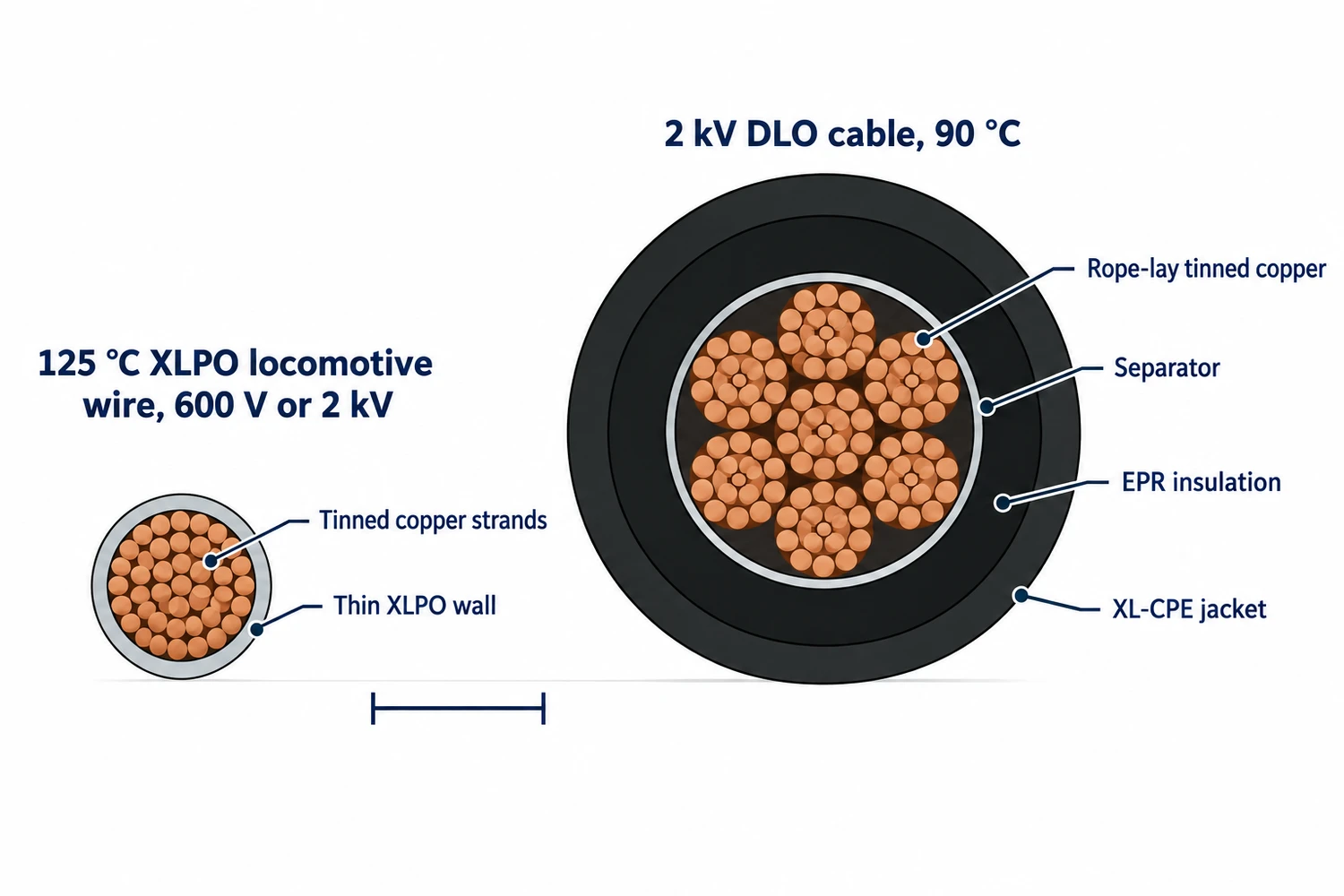
XLPO is cross-linked polyolefin, the broader family that includes XLPE, formulated and usually irradiation-cross-linked for thin-wall single wires rated 125 °C with flame-retardant, low-smoke or halogen-free performance. On a locomotive it is the insulation of the 125 °C AAR RP-585/S-501 wiring inside the carbody, while EPR is the insulation of the 2 kV DLO power cable that feeds traction motors.
The two are not competitors so much as neighbours. A 125 °C XLPO locomotive wire such as the Marmon Exane 1069A is specified from −55 °C to 125 °C with a 130 °C overload and 250 °C short-circuit rating, built to AAR RP-585/S-501 with insulation to ICEA S-95-658, and its maker claims better cut-through, crush and scrape resistance than EPR (Marmon spec sheet ET03, 2023; the same construction class is described by Sycor). That is a thin-wall, single-conductor wire for panel and carbody wiring, where a 125 °C rating buys ampacity in a small space and low smoke buys the fire performance rail specifications demand. DLO, by contrast, is a 90 °C, 2 kV, thick-wall power cable whose rope-lay conductor and EPR wall are chosen for bending and re-termination at overhaul; TEBAOFLEX builds it with thermoset EPR rated 90 °C wet or dry and a −40 °C cold bend, as its DLO cable page records.
| Cable | Insulation | Conductor rating | Choose this when |
|---|---|---|---|
| Traction motor, generator and battery power leads | EPR (thermoset), XL-CPE jacket | 90 °C wet or dry, 2 kV | Flexing, vibration and re-termination at overhaul: DLO cable 2 kV |
| Carbody and panel wiring, single wires | XLPO, irradiation cross-linked | 125 °C, 600 V or 2 kV (AAR RP-585/S-501) | Space is tight and low-smoke, halogen-free performance is specified; send the AAR designation and sizes to engineering for review |
| Shipboard and offshore power circuits | XLPO (Type P) | Per IEEE 1580 construction | Marine fire performance is mandated: Type P power cable 5C |
| Appliance and equipment hook-up wire, 300–600 V | XLPE or XLPO, UL AWM styles | 90 °C to 150 °C | A single wall, easy stripping, UL style number on the drawing: UL XLPE and XLPO hook-up wire |
| Mine feeder in a fixed route | XLPE, screened | 90 °C, 6/10 kV and up | Installed once, longest run, lowest loss |
Where the temperature ceiling climbs past 125 °C, none of the three is the answer; that is silicone and fluoropolymer territory, covered separately in what high-temperature wire insulation ratings actually promise.
Does EPR insulation mean 90 °C or 105 °C?
EPR insulation is rated 90 °C conductor temperature and 250 °C short circuit under IEC 60502-1 and in the ICEA S-75-381 portable cable constructions; the 105 °C figure belongs to MV-105 grade EPR built to ICEA S-93-639 and UL 1072, which also carries a 140 °C emergency rating. Read the standard named on the datasheet before you read the number.
The confusion is understandable because both numbers are true for “EPR”. IEC 60502-1:2021 Table 3 gives EPR and HEPR the same 90 °C / 250 °C limits as XLPE. North American medium-voltage EPR compounds qualified under ICEA S-93-639/NEMA WC 74 and UL 1072 are marketed as MV-105, with 105 °C normal, 140 °C emergency and 250 °C short-circuit ratings, against 90 °C / 130 °C / 250 °C for tree-retardant XLPE in the same standards (Border States via Tano Cable, above). TEBAOFLEX’s flexible MV-105 single-conductor EPR cable is built on the 105 °C compound; its Type W, G-GC and SHD-GC portable cables are built on the 90 °C compound the mining standard calls for. Ampacity tables follow the rating, so a 105 °C table applied to a 90 °C cable overloads it by design.
At the cold end the two polymers are closer than folklore suggests. Southwire’s installation guidance sets the same −40 °C minimum installation temperature for EPR, EPDM, XLPE and PE, and a warmer −20 °C for CPE and CSPE jackets and −10 °C for PVC (Southwire, 2023). The difference is not whether the wall survives one cold bend at installation; it is whether it survives ten thousand of them in service, and that is the modulus question the elastomer wins. It is also why the jacket, not the EPR, usually sets a flexible cable’s cold limit.
How to read EPR on a datasheet and write it into an enquiry
Read the standard and the compound code, not the marketing name. In North America the R in UL 44 types RHH and RHW-2 means “thermoset” and can be either EPR or XLPE, so it does not identify the material; in Europe EI4 under EN 50363 identifies an ethylene propylene rubber insulation, and in German-designation flexible cables the G in codes such as NSGAFÖU or (N)TSCGEWÖU stands for rubber insulation, with 3GI3 marking the medium-voltage EPR grade.
Three letters cause most of the avoidable arguments. “RHH/RHW-2” on a DLO or Type W datasheet is a UL 44 wire type, not a compound; Southwire’s compound note lists UL 44 alongside ICEA S-95-658 and UL 1072 as standards an EPR compound is qualified to, which is exactly why the letter cannot tell you what is inside. “EPDM” on one datasheet and “EPR” on another are, in practice, the same class of compound, as IEC 60502-1’s definition confirms. And “rubber” in a European designation such as H07RN-F points to the EI4 compound family, which is EPR-based, rather than to natural rubber. When two quotations disagree on the insulation, ask each supplier for the compound designation and the standard it is qualified to, and the disagreement usually evaporates.
- State the voltage class and whether the cable is shielded, using the standard’s own terms (2 kV Type W, 8.7/15 kV SHD-GC, 6/10 kV (N)TSCGEWÖU).
- State the conductor temperature rating you will size ampacity against: 90 °C, or 105 °C only for an MV-105 construction.
- State the duty: fixed, trailing, reeling with drum diameter and travel speed, festoon, or vibration only. This decides whether EPR is required or merely acceptable.
- State the environment the jacket must survive: wet, oil, ozone and sunlight, abrasion, minimum ambient. The insulation does not carry this load; the sheath does.
- Name the construction standard the quotation must reference, such as ICEA S-75-381, UL 1650, EN 50525-2-21 or IEC 60502-1, and ask for the compound designation on the datasheet.
Buying questions before the first EPR cable order
Which certification actually covers an EPR-insulated flexible cable for my market?
For the European market, TEBAOFLEX holds VDE Marks Approval certificate 40060056, issued 2025-03-28, for cross-linked elastomer insulated flexible cables to DIN EN 50525-2-21 (VDE 0285-525-2-21):2012-01 / EN 50525-2-21:2011, the standard behind the H07RN-F family; for North American portable cords it holds UL 62 and CSA C22.2 No. 49 certification, detailed below.
The North American certificates are UL-US-2449012-4 under UL 62, category ZJCZ Flexible Cord, and UL-CA-2437036-5 to CSA C22.2 No. 49 under ZJCZ7, both issued 2024-12-27 and maintained under Follow-Up Service. Type W, G-GC, SHD-GC and DLO constructions are designed and manufactured to the ICEA, UL 1650 and UL 44 references named on their product pages; those references are not UL Listings, and no MSHA approval is claimed for them. If your project needs a specific listing or mine-safety approval, state it in the enquiry and the engineering team will confirm what documentation can be supplied.
Can we order a trial length before committing to a production run?
The minimum order quantity is 50 m as of August 2026, and it is the same for standard and customised constructions, so a trial reel of an EPR trailing cable does not carry a premium. Confirm the current minimum when you enquire, since it is reviewed periodically.
How long does an EPR cable order take?
Standard lead time runs 7 to 45 working days as of August 2026, depending on product type, stock position and how much of the construction is customised. Confirm current timing with the engineering team before you commit it to a shutdown or delivery window.
Can the jacket be changed on an EPR construction?
The EPR insulation and the sheath are separate layers with separate jobs, so the jacket compound and its reinforcement can be specified per build within the construction’s design limits; CPE, PCP and polyurethane options appear on the individual product pages. Send the duty and the environment, and engineering will confirm what the construction supports and what documentation comes with it.
Questions
Is EPR the same as EPDM?
In cable insulation, yes for practical purposes: EPDM is the diene-modified version of ethylene propylene rubber, and IEC 60502-1 defines EPR as “ethylene propylene rubber or similar (EPM or EPDM)”. A datasheet that says EPDM and one that says EPR are describing the same class of compound.
Is EPR the same as PVC?
No. PVC is a thermoplastic that IEC 60502-1 limits to 70 °C in normal operation and 140 °C or 160 °C in a short circuit, depending on conductor size; it softens with heat and stiffens in the cold. EPR is a cross-linked thermoset rated 90 °C and 250 °C that cannot melt and stays flexible at low temperature.
Can EPR-insulated cable be used outdoors and in wet locations?
Yes, with a suitable jacket. EPR is inherently resistant to ozone, sunlight and moisture and has low sensitivity to water treeing; portable mining constructions built to ICEA S-75-381 are rated 90 °C wet or dry and sunlight resistant. Oil and abrasion resistance come from the sheath, so specify the sheath for the site, not just the insulation.
Does EPR insulation require a tinned copper conductor?
No. Unlike older rubber compounds, EPR does not attack bare copper, so tinning is not needed to protect the insulation. Tinned conductors are still specified on DLO, mining and marine cables for corrosion resistance and termination reasons, which is a separate decision covered in the DLO cable guide.
Send the duty, not just the compound
Pick EPR when the cable moves, gets wet or sits on a drive circuit, pick XLPE when it is installed once and asked to carry medium voltage cheaply for decades, and pick XLPO when a thin wall at 125 °C and low-smoke performance matter more than flexing. If two of those pull in different directions, that is the conversation worth having before the reel is cut.
Send the voltage class, conductor size, movement duty, ambient range and the standard your project references, and the engineering team will confirm the insulation, the jacket and the current lead time for the construction that fits.