

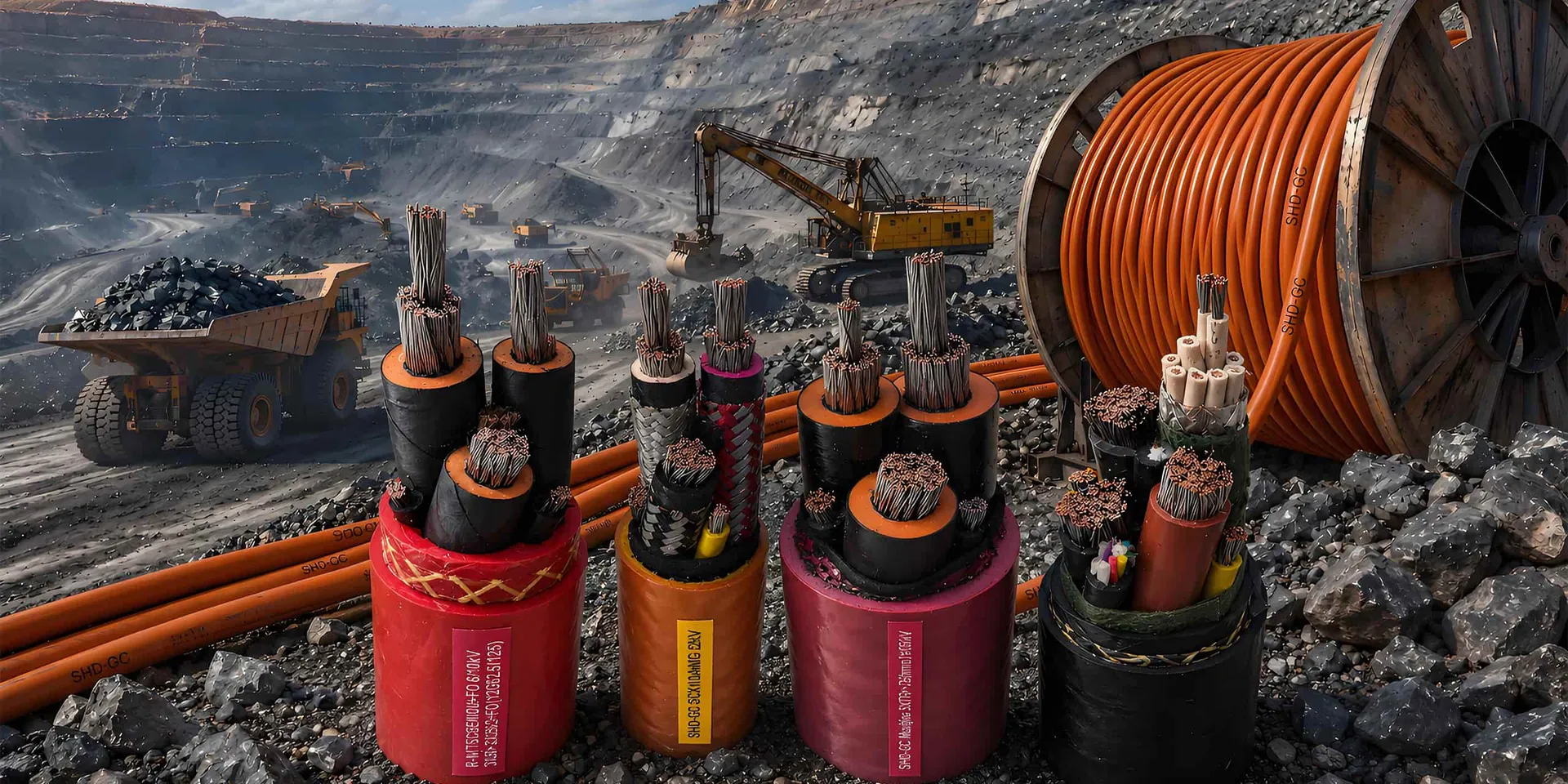
Mining Cable Manufacturer for Trailing, Reeling and Feeder Cable
We are a mining cable manufacturer that builds to four different standard families — AS/NZS 1802 and 2802, BS 6708, ICEA/UL and VDE/DIN — from one factory in Jiangsu, China. Over 100 mining cable types are already engineered, documented and in production. Tell us the machine and the jurisdiction; we will tell you the type number.
- 100+ mining cable types in production
- 0.6/1 kV to 19/33 kV
- UL · cUL · VDE certificates for flexible cables (UL 62 / CSA C22.2 No. 49; EN 50525-2-21)
- MOQ 50 m
- Lead time 7–45 working days
Why a mining cable is a different animal
A mining cable is a flexible power cable built to be dragged, wound, crushed and flooded every shift, with an earth-continuity pilot core so the supply trips before a person does. Fixed-installation cable is designed to be installed once and left alone. Mining cable is designed to be abused continuously and to fail safe when the abuse finally wins.
That difference shows up in every layer. The conductors are rope-lay stranded rather than compacted, so the cable survives bending cycles instead of work-hardening. The insulation is EPR or an elastomer rather than XLPE, because it has to stay flexible at −25 °C and after ten thousand drum wraps. The sheath is CPE, PCP or PUR rather than PVC, because it is going to be dragged across shot rock. And there is almost always a pilot or ground-check core whose only job is to notice that the earth path has broken and open the breaker before anyone finds out the hard way.
Put ordinary building wire on a reeling drum and it has roughly the life expectancy of a mayfly. That is not a marketing line — it is why every mining jurisdiction on earth wrote its own cable standard instead of letting people use general-purpose cable.
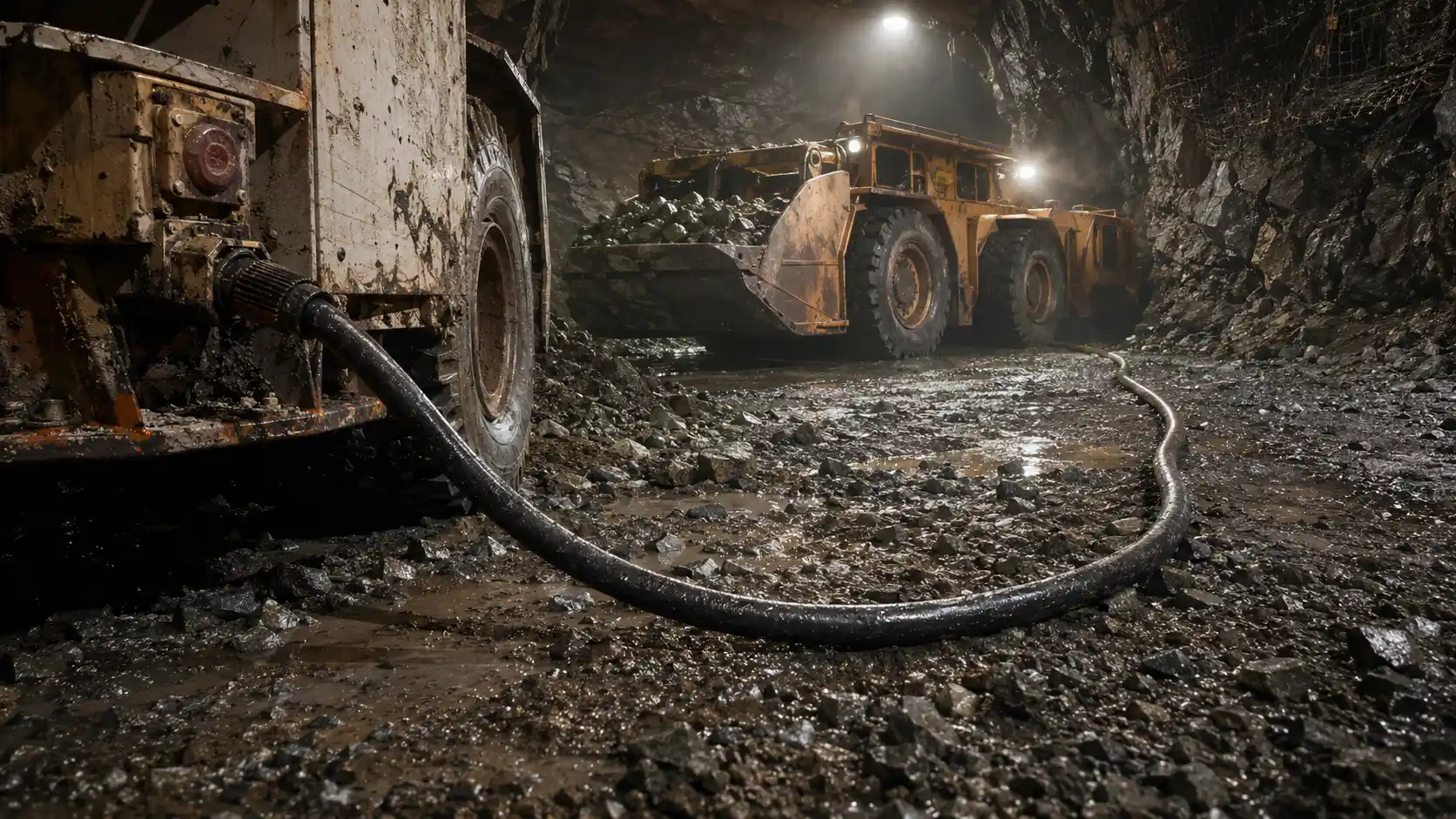
Mining cables we manufacture
Six families cover almost every powered thing in a mine. As a mining cables manufacturer we build all six on the same lines, which matters more than it sounds: one supplier, one set of drum marks, one set of test reports.
Trailing cables
For continuous miners, loaders, shuttle cars and drills. Dragged along the floor, so the sheath is the wear part. Rope-lay conductors, ground-check core, heavy CPE or PCP sheath.
Reeling cables
For shovels, stackers, reclaimers and drum-mounted machines. The failure mode is torsion and drum crush, not abrasion, so the lay and the core arrangement are what count.
Feeder and distribution cables
MV runs from the substation to the face or the pit, up to 19/33 kV. Screened per core, armoured where the route demands it.
Drill and jumbo cables
Short, brutally worked lengths on drill rigs and jumbos. Tension and repeated flexing at the reel entry are the killers.
Tunnelling and TBM cables
Reeling and festoon cable for tunnel boring machines, plus monitored designs where the tunnel authority wants earth continuity proven continuously.
Control, pilot and signal cables
Screened control and instrumentation running alongside the power core, in the same sheath or as a separate harness.
Which standard does your mine actually need?
The standard is decided by the jurisdiction and by whether the mine is underground coal, not by the machine. Get this wrong and the cable is perfectly good and completely unusable, because the site electrician cannot accept it. Start here, then pick the type number.
| Where the mine is | Mine type | Standard family | What it governs | Type numbers to ask for |
|---|---|---|---|---|
| Australia, New Zealand | Surface and underground, other than underground coal | AS/NZS 2802 | Reeling and trailing cables, 1.1/1.1 kV to 33/33 kV, two classes. A pilot core arranged to cut the supply on loss of earth continuity is mandatory. | Type 409, 440, 441, 450, 451, 455, Mine Feeder Type 1 / 2S |
| Australia, New Zealand | Underground metalliferous (and underground coal practice) | AS/NZS 1802 | Reeling and trailing cables for underground use; application to metalliferous mines requires a risk assessment by a competent person. | Type 240, 241, 245, 260, 275 |
| Australia, New Zealand | Any — in service | AS 1747 | Repair, testing and fitting of accessories. Routine testing every 3 months on surface, monthly underground, in quarries and on dredges. | Applies to all of the above |
| UK, South Africa, India, much of Africa | Surface and underground | BS 6708 | Flexible cables for mining machinery, LV through MV, including flat and drill constructions. | Type 11, 14, 16, 20/21, 43, 44, 201/211, 307, 321/331, 630/631, 730, FS4 |
| North America, much of Latin America | Surface and underground | ICEA S-75-381 / NEMA WC-58, UL | Portable power cables for mining: shielded and unshielded, with and without ground-check. | Type W, Type G, Type G-GC, SHD-GC, MP-GC |
| Germany, EU, and most TBM projects worldwide | Mining and tunnelling | VDE / DIN (with EN 50525, IEC 60502) | Rubber-sheathed flexible mining and tunnelling cable, including screened and monitored designs. | NTSCGECWOU, NTSKCGECWOEU, NSSHKCGEOEU, NSHXOEU, 3GSEYQY, N3GHSSHCH |
Sources for the Australian rows: WorkSafe Western Australia — trailing and reeling cables, which sets out the AS/NZS 2802 scope exclusion for underground coal, the mandatory pilot core, and the 3-monthly and monthly test intervals under AS 1747.
Four standard families, one factory
Most mining cable makers are fluent in one standard family. We build and document four. That is the single most useful thing to know about us, so here it is as a table rather than as a paragraph about our commitment to excellence. Every type number below links to its own specification page on this site — go and check.
| Standard family | Types in production | Representative type numbers | Typical market |
|---|---|---|---|
| VDE / DIN rubber-sheathed mining & tunnelling | 43 | NTSCGECECWOU TBM reeling · NTSCGECWOU TBM · NTSKCGECWOEU coal cutter · NSSHKCGEOEU · NSHXOEU · 3GSEYQY 18/30 kV · N3GHSSHCH · NTSCGEWOU distribution | Europe, TBM and tunnelling projects worldwide |
| BS 6708 flexible cables for mining machinery | 20 | Type 11 · Type 16 · Type 43 drill · Type 307 · Type 321/331 · Type 630/631 · Type 730 · Type FS4 flat | UK, South Africa, India, much of Africa |
| ICEA S-75-381 / UL portable power cables for mining | 13 | SHD-GC 2–25 kV · Type G-GC 2 kV · Type W 600/2000 V · Type SHD-CGC 5 kV · Type SHD-PCG 2 kV | North America, Latin America |
| AS/NZS 2802 reeling & trailing, other than underground coal | 9 | Type 409 · Type 440 · Type 441 Class 1 · Type 451 · Type 455 · Mine Feeder Type 1 | Australia, Chile, Indonesia |
| AS/NZS 1802 underground reeling & trailing | 7 | Type 240 · Type 241 · Type 245 · Type 260 armoured screened · Type 275 | Australian underground mines |
| IEC 60502 fixed MV distribution | 7 | Screened MV power for substation and fixed runs, quoted alongside the flexible types | Worldwide |
Counts are of live specification pages in our mining and tunnelling cable range, not of catalogue line items. If your type number is not in the table, it is very likely still in the range — ask.
Mining power cable: LV feeder to 33 kV
As a mining power cable manufacturer we build the whole voltage ladder, from 0.6/1 kV machine trailing cable up to 19/33 kV feeders. The voltage decides the screening, and the screening decides how the cable behaves when it is dragged — which is why voltage is the second question we ask after the standard.
| Voltage class | What it feeds | Screening | What changes in handling |
|---|---|---|---|
| 0.6/1 kV | Loaders, drills, pumps, lighting, conveyor drives | Usually unscreened; earth cores laid in the interstices | Most flexible of the range. Sheath abrasion is the life-limiting factor. |
| 1.9/3.3 kV – 3.6/6 kV | Larger machine drives, small distribution | Semi-conductive layer or per-core screen | Screens must be continuous under bending — a broken screen is an invisible fault until it is a very visible one. |
| 6/10 kV – 8.7/15 kV | Shovels, draglines, face distribution, TBM supply | Individually screened cores, ground-check core | Minimum bend radius grows sharply. Drum and sheave sizing stop being a detail. |
| 12/20 kV – 19/33 kV | Substation to pit, main feeders, stackers and reclaimers | Individually screened, often armoured | Handling, jointing and termination become the project. Repair kits are ordered with the cable, not after it. |
Power, control, pilot and signal in one harness
The other half of being a mining electrical cable manufacturer is everything that is not power. A face machine typically needs the power cores, one or two earth cores, a ground-check or pilot core, and often a screened control pair or a fibre for the machine network. We build those as combined constructions where the machine has one entry, and as separate cables where it has two. What we will not do is quote a power cable and let you find out on site that the control cores were somebody else’s problem.
When the control, signalling and bus circuits on an open-cast mine run as a separate cable alongside conveyor belts or on material-handling equipment, the 2YSLGCGOEU signal and control cable carries them on paired cores under a tinned copper braid screen.
Heavy-duty duty cycles: what actually kills a mining cable
Mining cables almost never fail from electrical overload. They fail mechanically, and then electrically. Choosing a heavy-duty mining cable manufacturer is really about choosing which of these five failure modes you are buying protection against, because the constructions that resist them are not the same construction.
| Failure mode | Where it happens | What it looks like | What the construction has to do |
|---|---|---|---|
| Sheath abrasion | Trailing cable dragged over shot rock and rail | Sheath thins on one side until the earth core shows | Heavy-wall CPE or PCP sheath; PUR where the abrasion is severe and the cable stays reasonably clean |
| Corkscrewing | Reeling cable on a drum, and trailing cable pulled around corners | The cable takes a permanent helix and will not lie flat or spool evenly | Balanced lay length and core arrangement; the cores have to be free to move relative to each other inside the sheath |
| Torsion fatigue | Reel entry, festoon trolleys, drill masts | Conductor strands break inside an intact sheath — resistance climbs before anything is visible | Rope-lay stranding to a fine class, short lay, and enough room in the sheath for the cores to twist |
| Crush and impact | Anywhere a machine can run over the cable | Flattened section; insulation displaced onto the screen | Sheath thickness plus a filler package that spreads the load instead of transmitting it |
| Earth path loss | Everywhere — and it is the one that hurts people | Nothing. That is the problem. | A pilot or ground-check core arranged so the supply trips when continuity is lost, which is exactly why AS/NZS 2802 makes it mandatory rather than optional |
Cold matters too. At −25 °C the wrong elastomer stops being a cable and becomes a length of pipe, and the first machine to move it cracks the sheath. Tell us the winter low along with everything else; it is a compound decision, not an afterthought.
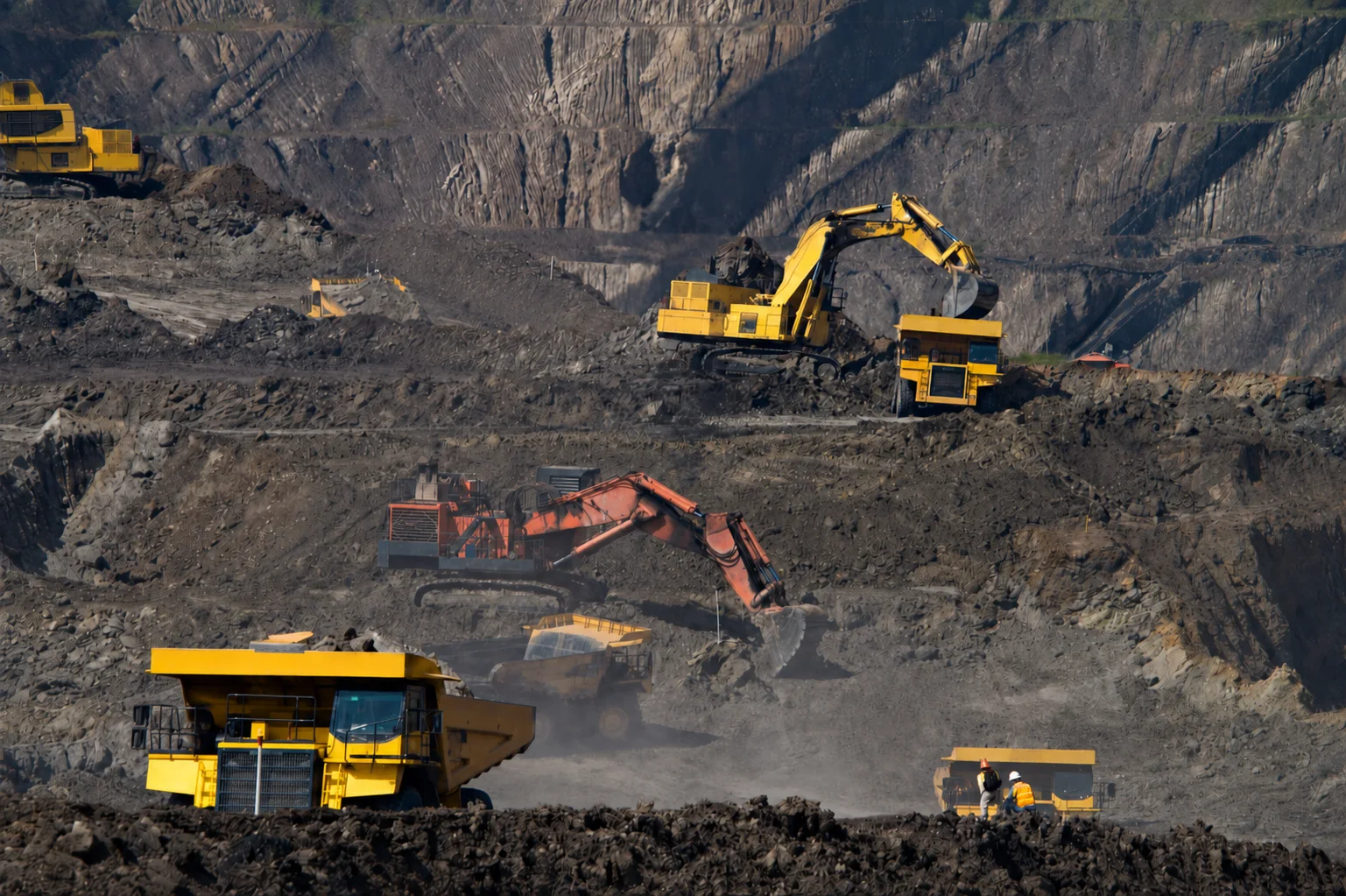
Mining cables we build and export
Three of the workhorses, with real specifications behind them. The full range runs to more than a hundred type numbers.
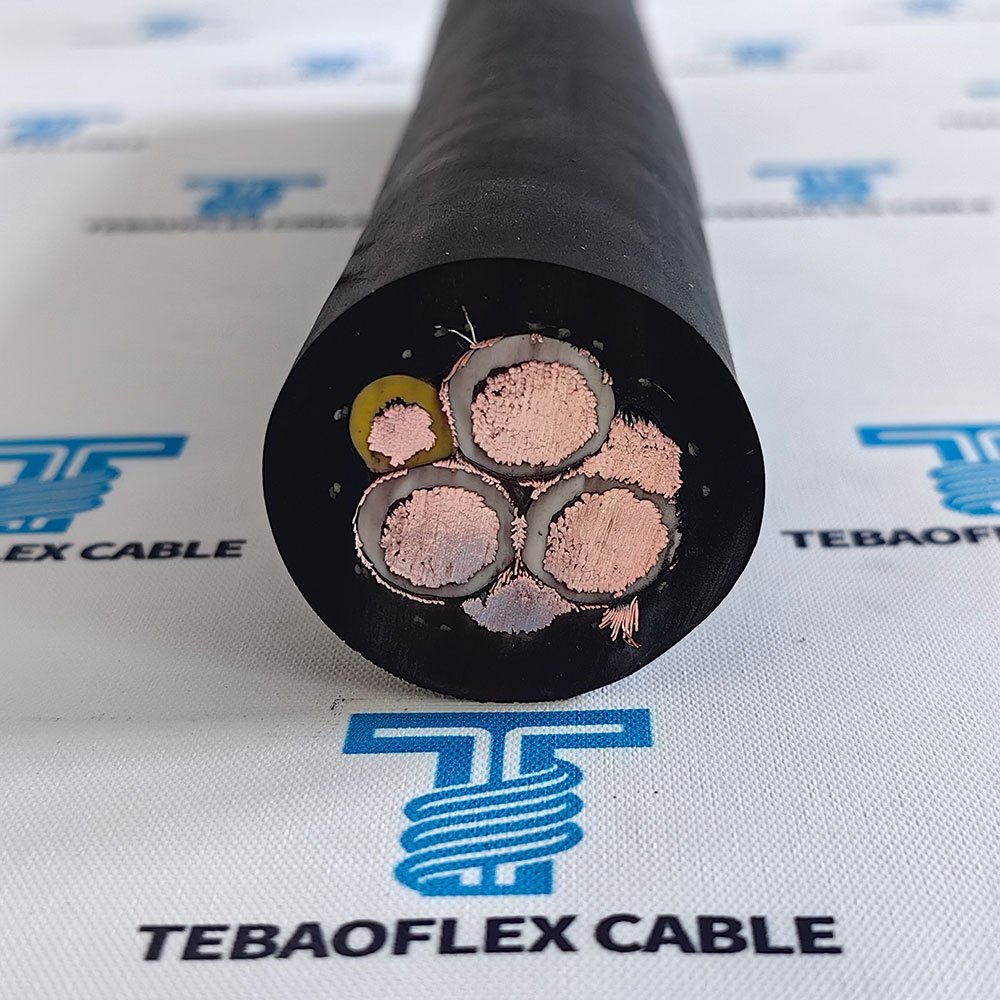
SHD-GC Mining Power Cable
- Shielded round portable, ICEA S-75-381
- Three EPR-insulated tinned-copper power cores, 90 °C
- Grounding plus ground-check conductor
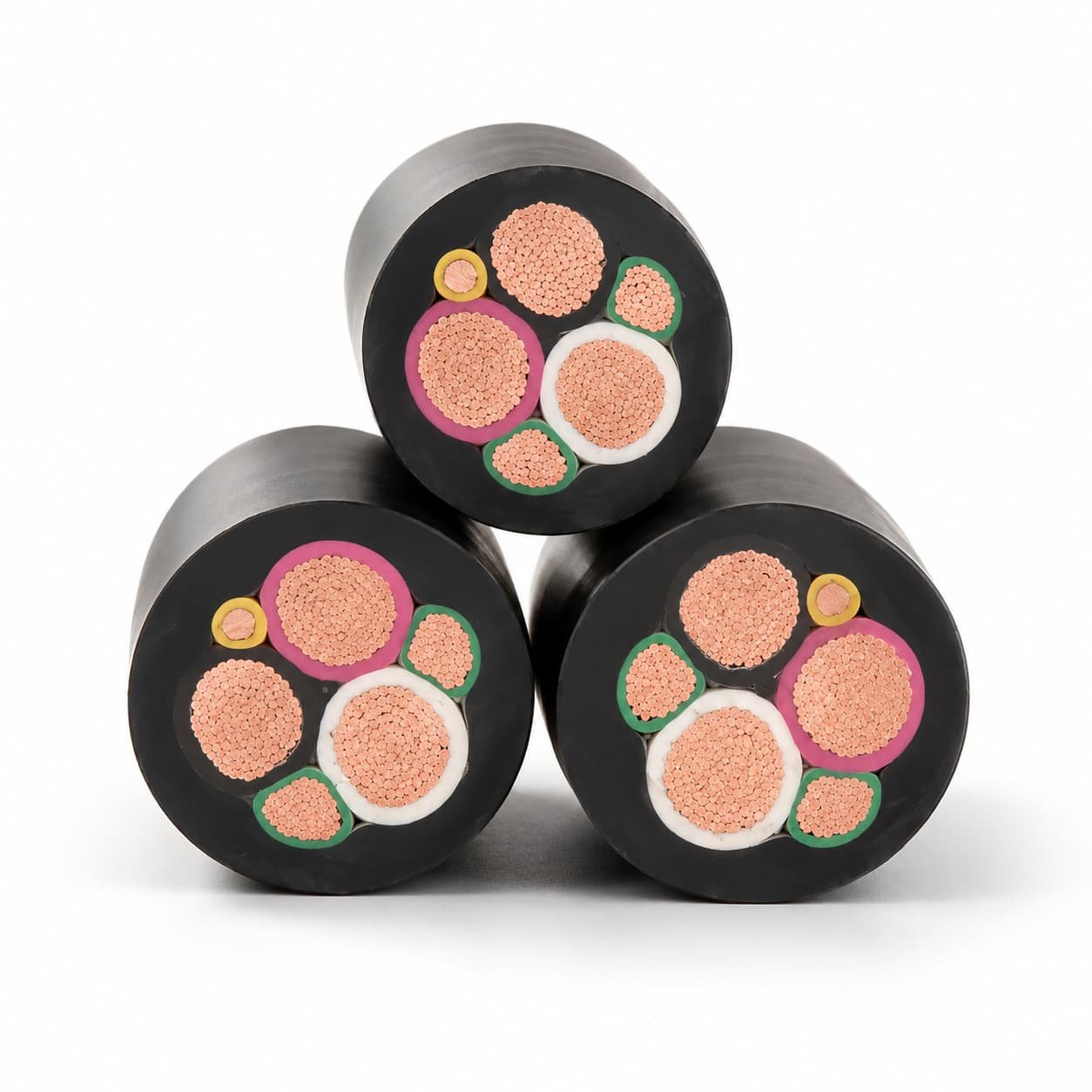
Type G-GC Portable Mining Cable
- Round portable, three rope-lay tinned-copper power cores
- Two grounding conductors plus one ground-check core
- The default for continuous miners and face equipment
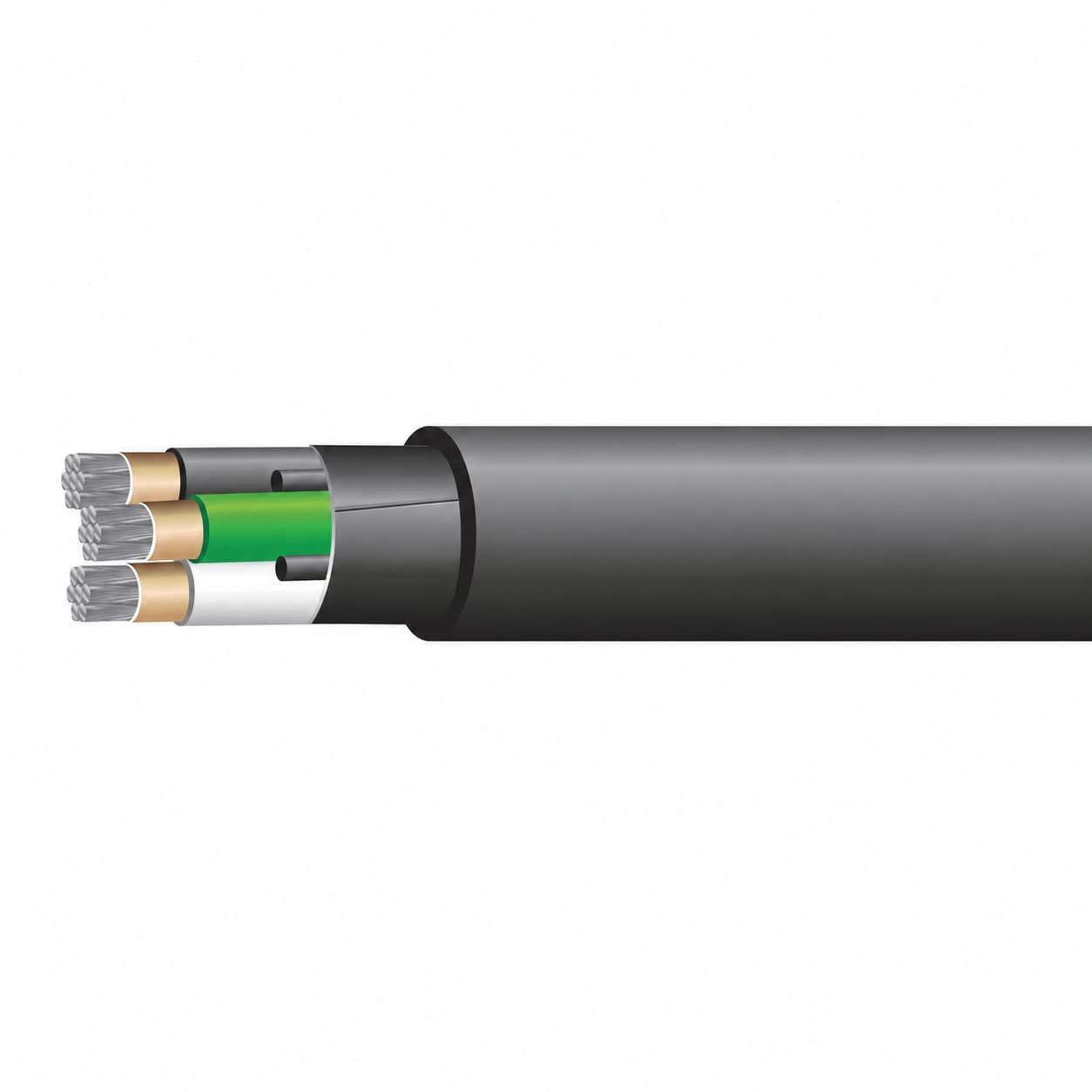
Type W Portable Power Cable
- Three-conductor round, unshielded
- Annealed tin-coated rope-stranded copper to ASTM B-172 / B-33
- Open-pit mobile equipment and general portable power
Browsing rather than specifying? The whole catalogue sits in mining and tunnelling cables, and if you are still deciding between families, our mining cable selection guide walks through the types without trying to sell you one.
Standards and certifications — including what we do not hold
We publish our certificate numbers, and we publish the gaps. Every comparison article about mining cable manufacturers skips certification entirely, which is convenient for everyone writing them. Here is the whole picture, so nobody discovers a problem in round three of a tender.
What we hold, with numbers
UL — UL-US-2449012-4, UL 62 flexible cord, issued 2024-12-27, report E542560-20241225
cUL — UL-CA-2437036-5, CSA C22.2 No. 49 flexible cord, issued 2024-12-27
VDE — 40060056, EN 50525-2-21 rubber-sheathed flexible cables, issued 2025-03-28
Testing to CE, UL, VDE and KTL regimes on 8 in-house test rigs.
What we build to, as design and test references
AS/NZS 1802 and AS/NZS 2802 constructions and type numbers
BS 6708 type numbers
ICEA S-75-381 / NEMA WC-58 portable power cable constructions
IEC 60502, IEC 60228 conductor classes, EN 50525
DIN / VDE 0250 rubber-sheathed mining and tunnelling designs
Building to a standard and holding a national approval to it are different things — ask us which applies to your tender and we will answer straight.
CE marking: a voluntary Verification of Conformity (VoC) covers our rubber-sheathed flexible cables; it is not a certification and does not appear in the list above. RoHS and REACH declarations are issued on EU-bound cable.
Standards themselves are published by their own bodies, not by us — see the IEC for the 60228 and 60502 series, and your local mining regulator for what is enforceable on your site.
How to compare mining cable manufacturers
Most rankings of mining cable manufacturers compare brand, region and R&D spend — and skip certification, capacity and price entirely. Those three are the ones that decide whether your order arrives. Here is the checklist we would use if we were buying, including the questions we find least comfortable.
| Ask them | A good answer sounds like | A bad answer sounds like |
|---|---|---|
| Which standard family is this built to, and can you issue a declaration against it? | A named standard, a type number, and yes or a clear no | “International standards” |
| Show me the certificate numbers | Numbers, issue dates and the issuing body | A logo wall |
| Are you the factory or a trading company? | An address, a plant area, a line count, and an open door for an audit | “We work with the best factories” |
| What is the minimum order, really? | A number in metres | “Depends on the project” |
| Lead time from confirmed order | A range in days, confirmed before you pay | “As soon as possible” |
| Non-standard cross-section or core count? | Yes, with a tooling and sample timeline | Silence, then a catalogue page |
| Continuous length and drum type | Length per drum, flange dimensions, drum options | “Standard packing” |
| Repair and accessory support after delivery | Named repair practice and available kits | Nothing — and repairs are where mining cable spends most of its life |
Our answers, in order: named standard and type number, declaration yes; the certificate numbers are in the section above; factory at No. 77 Wusongbang Road, Taicang, Jiangsu, 20,000+ m², 12 production lines, audits welcome; MOQ 50 m; 7–45 working days; non-standard yes with a sample first; drum type and length to your specification; and repair guidance from the engineers who built the cable.
Buying from a China mining cable manufacturer
The honest reason to buy from a China mining cable manufacturer is cost and lead time; the honest risk is that you cannot see the factory. So we make the factory checkable rather than asking you to take it on faith.
The factory, in checkable numbers
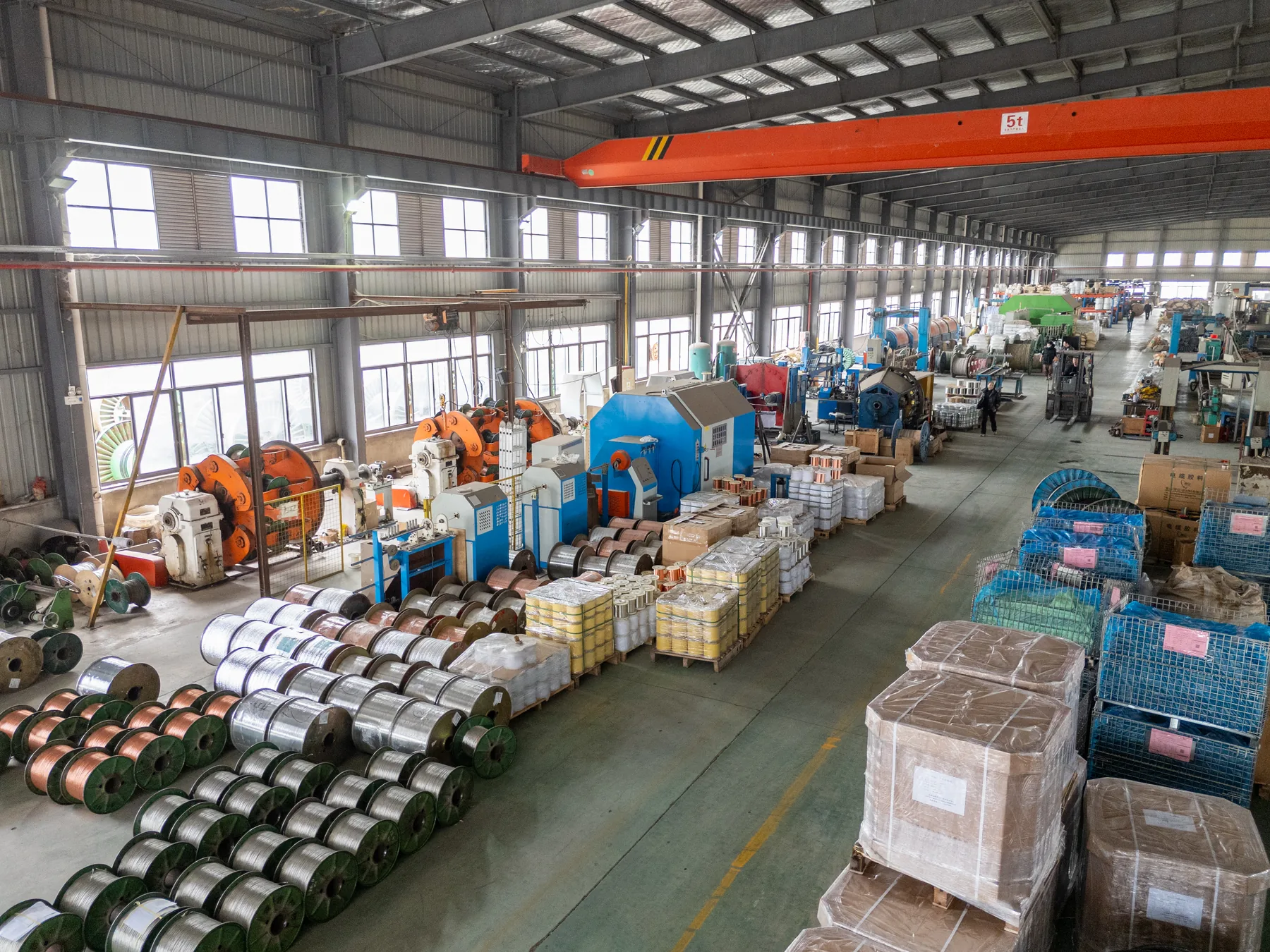
Jiangsu TEBAOFLEX Special Cable Co., Ltd, producing since 14 October 2014. No. 77 Wusongbang Road, Fuqiao Town, Taicang City, Jiangsu. 20,000+ m² site with 15,000 m² of workshops and warehouses, 12 automated lines covering rubber mixing, extrusion, braided shielding, cabling and packaging, 8 test rigs, 150,000 km annual capacity, roughly 15 tonnes of copper a day, 30+ engineers and 20+ patents. Independent import and export licences.
Commercial terms, stated up front
MOQ 50 m, so a trial order is a real option. OEM and ODM — your brand printed on the cable and the drum. Lead time 7–45 working days, confirmed in the written quotation. Steel, steel-wooden, wooden and export plastic drums, with under-drum brackets.
Exported to 20+ countries, with cable supplied to projects of Glencore, Anglo American, BHP, Rio Tinto and Freeport, across the DRC, Zambia, South Africa, Guinea, Chile, Peru, Brazil, Argentina, Indonesia, Malaysia, Vietnam, Australia, Russia, Germany and the UAE. Recent jobs are written up in our project cases.
Custom and OEM mining cable manufacturing
Roughly half of what leaves the plant is not a catalogue item. If the machine came with a cable that no longer exists, or the standard type does not fit the gland, that is a normal request rather than a difficult one.
Non-standard constructions
Cross-sections and core counts outside the type table, extra pilot or signal cores, fibre in the same sheath, and combined power-plus-control harnesses.
Compound selection
CPE, PCP, PUR and low-temperature elastomers chosen against the actual abrasion, oil, ozone and winter-low conditions rather than against a default.
Marking, drums and logistics
Your brand and part number printed on the cable and the drum, continuous lengths to your reel capacity, drum type to your handling equipment, sea, land, air or combined shipment.
Related work worth a look: MV mining trailing cable and couplers, underground drill jumbo cable, and the wider mining and tunnelling solutions overview.
Get a mining cable quote
Send four things and we can quote without a back-and-forth: the machine, the voltage, the jurisdiction or standard, and the length and drum. If you have a type number, that replaces the first three.
If you do not know the standard, say where the mine is and whether it is underground coal — that is enough for us to work it out.
Or email sales@tebaoflexcablegroup.com — drawings, old drum tags and photographs of the failed cable are all useful.
Mining cable FAQ
What is a mining cable?
A mining cable is a flexible, rubber or elastomer sheathed power cable built to be dragged, reeled, crushed and flooded in daily service, with rope-lay stranded conductors and usually a pilot or ground-check core that opens the supply if earth continuity is lost. It is a safety device as much as a power cable.
What is the difference between a trailing cable and a reeling cable?
A trailing cable is dragged along the ground behind a machine, so abrasion and crush dominate and the sheath is the wear part. A reeling cable is wound onto a drum, so torsion and drum pressure dominate and the core lay matters more than sheath thickness. Using one for the other job shortens its life dramatically.
Which standard applies to my mine?
Jurisdiction and mine type decide it. Australia and New Zealand use AS/NZS 2802 for everything except underground coal and AS/NZS 1802 underground; the UK and much of Africa and India use BS 6708; North America uses ICEA S-75-381 with UL; Europe and most TBM projects use VDE and DIN designs. The table above maps them to type numbers.
Why does a mining cable need a pilot or ground-check core?
Because a broken earth path is invisible until someone completes the circuit. AS/NZS 2802 requires a pilot core arranged to cut off the supply if the earthing circuit breaks. Other standards achieve the same thing with a ground-check conductor. Either way it is not an optional extra.
How often does a mining cable have to be tested?
Under AS 1747 in Australia, routine testing is every three months for surface operations and every month for underground mines, quarries and dredges. Other jurisdictions set their own intervals. Testing and repair are also where most of the practical cost of owning mining cable actually sits.
What voltages do you manufacture?
From 0.6/1 kV machine trailing cable through 1.9/3.3, 3.6/6, 6/10 and 8.7/15 kV, up to 19/33 kV feeder and reeling cable. Above 3.3 kV the cores are individually screened, and the minimum bend radius grows enough that drum and sheave sizing becomes a design input rather than a detail.
Do you supply non-standard cross-sections?
Yes. Non-catalogue cross-sections, extra pilot or signal cores, fibre in the same sheath and combined power-plus-control harnesses are routine. We normally build a short sample first so you can fit it to the gland and the reel before committing to the full length.
What is the minimum order quantity?
50 metres. That is deliberately low so a new customer can run a trial length on one machine before committing to a site-wide changeover.
How long is the lead time?
7–45 working days from confirmed order, depending on construction and quantity; the written quotation confirms the actual date. Non-standard constructions add sample time at the front, which is stated separately in the quotation.
Can you print our brand on the cable?
Yes — OEM and ODM are standard here. Your brand, part number and metre marking on the cable, and your label on the drum. Tell us the exact print string and the drum marking format you use, because matching your existing stock records matters more than the logo.
Are you a factory or a trading company?
A factory. Jiangsu TEBAOFLEX Special Cable Co., Ltd has produced since 2014 at No. 77 Wusongbang Road, Taicang, Jiangsu, on a 20,000+ m² site with 12 automated lines and 8 test rigs. Audits are welcome, in person or by video, and we would rather you checked than wondered.
Which cable do I need for a tunnel boring machine?
TBM supply is normally a reeling cable in the VDE and DIN family — screened, rubber sheathed, and sized for the drum and the advance rate rather than only for the current. Monitored constructions are available where the tunnel authority wants earth continuity proven continuously rather than tested periodically.
Reviewed by the TEBAOFLEX cable engineering team — a real factory producing mining cable since 2014, holding UL and cUL certificates for UL 62 / CSA C22.2 No. 49 flexible cords and a VDE certificate for EN 50525-2-21 rubber-sheathed flexible cables. More about us on the company page, or talk to an engineer through contact.
Related cables and guides
Mining cable selection guide
The types, what each one is for, and how to read a designation — written to inform rather than to sell.
Browse mining and tunnelling cables
The full catalogue with specifications, cross-sections and datasheets for every type number on this page.
Mining and tunnelling solutions
Open-pit, underground and TBM applications, and which cable family belongs on each.
Ordering by a catalogue name?
TENAX, TROMMELFLEX, FELTOFLEX and SCHRÄM designations are mapped to the VDE types they describe, with the variant letters decoded, in our mining cable designation cross-reference. Every designation listed there can be quoted and supplied as a TEBAOFLEX build.